|
|
| Introduction, Specifications, Related Links | |||||||
Although they are not due to hit store shelves for a few more weeks, Intel is using the always exciting Game Developers Conference currently being held in San Francisco to officially unveil the new Core i7-980X Extreme processor. Intel's Extreme Edition processors have always been targeted at enthusiasts and hardcore-gamers, so what better place to show off the fastest desktop processor for the PC to date? Unless of course you're catching it here on the pages of HotHardware, that is.The new Core i7-980X Extreme is an interesting animal, however, that requires a detailed look. Although its branding implies that it may be just a simple speed-bump over the previous flagship Core i7-975 Extreme, the 980X is actually a totally different beast. And what a beast it is. While the Core i7-975 is based on the 45nm Bloomfield core and features quad execution cores, the new Core i7-980X Extreme is based on the 32nm Gulftown core and sports six execution cores. That's right folks, quad-cores are no longer king of the hill.
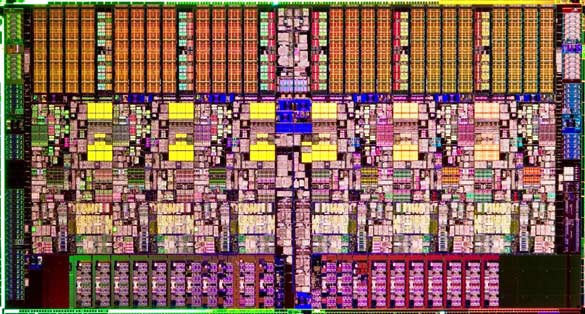
Intel Gulftown CPU Die: 50% More Cores, 50% More Cache ~ Same Power Consumption
The new Core i7-980X Extreme is based on the 32nm Gulftown core, which is derived from the 45nm Nehalem architecture that debuted with the original Core i7s. We've already posted a number of articles in the past detailing Nehalem in which we cover all its main features and specifications, and have even covered Gulftown a bit here and there. Due to the similarities between Gulftown and Nehalem, the two share many of the same capabilities. We have written about Nehalem's features in depth in our coverage of the original Core i7 launch, we've posted information on overclocking Nehalem, even under extreme conditions, and have covered other 32nm derivatives as well...
We're going to summarize Gulftown's main features as they relate to the Core i7-980X Extreme again here, but if you'd like to check out our complete coverage of the Core i7 family and the X58 Express chipset which supports it, the list of articles above offers up just about all there is to know. |
| Core i7-980X Ready Motherboards |
We should be clear from the start that the new Core i7-980X Extreme Edition processor should work in all existing X58-Express based motherboard designs, after a BIOS update. The chip uses the same socket and has the same TDP as current Core i7 processors. That didn't stop a couple of Intel's board partners from shipping some Gulftown-ready motherboards for testing though. The Gigabyte EX58A-UD5 may be familiar to some of you. It's an updated version of the EX58-UD5 (sans A) that's been a staple around the HH labs since its release. We've used the original UD5 as a testbed for everything from processors, to graphics cards, to solid state drives. The updated EX58A-UD5 builds upon the original by adding support for SATA 6G and USB 3.0, through the use of Marvell and NEC controllers, respectively. Asus also showed up to the party with the P6X58D Premium. Like Gigabyte's offering, the Asus P6X58D Premium features support for USB 3.0 and SATA 6G, and the board's chipset and VRM are cooled by large heatsinks, linked together via heat-pipes. |
| Test Systems and SiSoft SANDRA | ||||||||||||||||
|
Test System Configuration Notes: When configuring our test systems for this article, we first entered their respective system BIOSes and set each board to its "Optimized" or "High performance Defaults". We then saved the settings, re-entered the BIOS and set memory timings for either DDR3-1333 with 8,8,8,24 timings. The hard drives were then formatted, and Windows 7 Ultimate x64 was installed. When the Windows installation was complete, we updated the OS, and installed the drivers necessary for our components. Auto-Updating and Windows Defender were then disabled, finally, we installed all of our benchmarking software, performed a disk clean-up, defragged the hard drives, and ran all of the tests.
With the exception of the memory bandwidth test, where the new Core i7-980X Extreme was essentially tied with a couple of other Core i7 quad-core-based systems, it simply dominated the rest of the pack according to SiSoft SANDRA. The Core i7-980X Extreme's Processor Arithmetic and Multimedia benchmark scored were well ahead of its closes competition. Finally, the Cache and Memory Bandwidth test showed the Core i7-980X Extreme's additional cache and high frequency offered significantly more bandwidth than any other platform, regardless of the test block size. |
| Futuremark PCMark Vantage | ||||
Next up, we ran a number of different test systems through Futuremark’s latest system performance metric built especially for Windows Vista, PCMark Vantage. PCMark Vantage runs through a host of different usage scenarios to simulate different types of workloads including High Definition TV and movie playback and manipulation, gaming, image editing and manipulation, music compression, communications, and productivity. Most of the tests are multi-threaded as well, so the tests can exploit the additional resources offered by a quad-core CPU.
The new Core i7-980X Extreme finished well ahead of the other systems in terms of overall PCMarks, but in most of the other individual tests it was only marginally faster than the quad-core Core i7 975, with the sole exception being the Communications test. PCMark Vantage's Communications benchmark benefits from the Core i7-980X Extreme's new AES-NI (Advanced Encryption Standard New Instructions) which accelerate encryption and decryption algos in hardware, and as such, it simply blows past the other processors in that test. |
| LAME MT and x264 Encoding | ||||||||
In our custom LAME MT MP3 encoding test, we convert a large WAV file to the MP3 format, which is a popular scenario that many end users work with on a day-to-day basis to provide portability and storage of their digital audio content. LAME is an open-source mid to high bit-rate and VBR (variable bit rate) MP3 audio encoder that is used widely around the world in a multitude of third party applications.
In this test, we created our own 223MB WAV file (a hallucinogenically-induced Grateful Dead jam) and converted it to the MP3 format using the multi-thread capable LAME MT application in single and multi-thread modes. Processing times are recorded below, listed in seconds. Shorter times equate to better performance. There is not much to see here. A single instance of the LAME MT benchmark can process only two threads simultaneously, hence, the similarly clocked Core i7-980X Extreme and i7-975 perform right on top of each other here. What this tests does show is that there are no performance-improving core enhancements in the Gulftown core versus Bloomfield, however.
The Core i7-980X Extreme's additional cores and cache allowed it to pull well ahead of any other processor in the X.264 video encoding benchmark. Here, the Core i7-980X Extreme is between 14% and 48% faster than the Core i7-975 which is already measurably faster than the remaining processors in this test. |
| Cinebench R11.5 and POV-Ray | ||||||||
|
Cinebench R11.5 is an OpenGL 3D rendering performance test based on Cinema 4D from Maxon. Cinema 4D is a 3D rendering and animation tool suite used by 3D animation houses and producers like Sony Animation and many others. It's very demanding of system processor resources and is an excellent gauge of pure computational throughput.
This is a multi-threaded, multi-processor aware benchmark that renders a single 3D scene and tracks the length of the entire process. The rate at which each test system was able to render the entire scene is represented by the Cinebench scores in the graph below. The new Core i7-980X Extreme was once again the fastest of the bunch, by far. All else being equal, Cinebench R11.5 scales almost linearly with additional cores, as is evident by the Core i7-980X Extreme's approximate 49% lead over the Core i7-975--6 cores is 50% more than 4, and the processors are clocked the same, hence the almost 50% lead.
POV-Ray , or the Persistence of Vision Ray-Tracer, is a top-notch open source tool for creating realistically lit 3D graphics artwork. We tested with POV-Ray's standard 'all-CPU' benchmarking tool on all of our test machines, and recorded the scores reported for each. Results are measured in pixels-per-second throughput; higher scores equate to better performance.
POV-Ray tells us two things: 1) The additional compute resources of the Core i7-980X Extreme give it a huge boost in the multi-threaded rendering test over the next fastest processor, the Core i7-975. 2) When the shared L3 cache doesn't come into play, the individual cores in Gulftown are no faster than Bloomfield, clock for clock, as is evident by their near identical performance in the single-threaded test. |
| WinRAR Compression and Image Processing | ||||||||
In our custom WinRAR x64 benchmark, we take a directory loaded with two hundred, 12.1 megapixel image files and compress them into a single archive using the default WinRAR compression scheme. The length of time it took each system to save the completed archive is represented in the graph below.
The new Core i7-980X Extreme powered through our custom WinRAR x64 benchmark with the fastest time, but it was only a few percentage points faster than the Core i7-975.
For this next test, we use the VSO Image Resizer utility to convert two hundred, 12.1 megapixel image files copied directly from a digital SLR camera to compressed, 640x480 JPGs, suitable for the web. We used the Lanczos filtering method available within the application, which is slower, but offers higher quality compression than most other methods.
This test is single-threaded and does not benefit from additional processing cores. Due to this fact, the Core i7-980X Extreme performs right on par with the similarly clocked Core i7-975. |
| 3DMark06 and Vantage CPU Tests | ||||||||
3DMark06's built-in CPU test is a multi-threaded DirectX gaming metric that's useful for comparing relative performance between similarly equipped systems. This test consists of two different 3D scenes that are processed with a software renderer that is dependent on the host CPU's performance. Calculations that are normally reserved for your 3D accelerator are instead sent to the CPU for processing and rendering. The frame-rate generated in each test is used to determine the final score.
We saw more of the same with 3DMark06's built-in CPU benchmark. Here, the Core i7-980X Extreme pulled ahead of everything else by a decent margin.
3DMark Vantage's CPU Test 2 is a multi-threaded test designed for comparing relative game physics processing performance between systems. This test consists of a single scene that features an air race of sorts, with a complex configuration of gates. There are aircraft in the test that trail smoke and collide with various cloth and soft-body obstacles, each other, and the ground. The smoke spreads, and reacts to the planes as they pass through it as well and all of this is calculated on the host CPU.
The Core i7-980X Extreme's lead in 3DMark Vantage's CPU Test 2 was much more pronounced than its predecessor. In this benchmark, Intel's new baby is approximately 50% faster than the 975. |
| Low-Res Gaming: Crysis and ETQW | ||||
For our next set of tests, we moved on to some in-game benchmarking with Crysis and Enemy Territory: Quake Wars. When testing processors with Crysis or ET:QW, we drop the resolution to 800x600, and reduce all of the in-game graphical options to their minimum values to isolate CPU and memory performance as much as possible. However, the in-game effects, which control the level of detail for the games' physics engines and particle systems, are left at their maximum values, since these actually do place some load on the CPU rather than GPU.
In both the Crysis CPU benchmark and our custom Enemy Territory: Quake Wars test, the new Core i7-980X Extreme finishes well ahead of the competition. The additional cache will help in many game engines and the additional cores in many others. |
| Total System Power Consumption | ||||
We'd like to cover a few final data points before bringing this article to a close. Throughout all of our benchmarking and testing, we monitored how much power our test systems consumed using a power meter. Our goal was to give you all an idea as to how much power each configuration used while idling and while under a heavy workload. Please keep in mind that we were testing total system power consumption at the outlet here, not just the power being drawn by the processors alone.
Admittedly, this graph may look kinda boring, with relatively small deltas separating the high-end parts. But when you consider the Core i7-980X Extreme has 50% more cores and cache than the Core i7-975 and that it can be 50% faster (or more) with many workloads, the 980X's power consumption appears rather impressive. You get far more performance per watt with the new Core i7-980X Extreme in multi-threaded workloads versus any other CPU. |
| Performance Summary and Conclusion | ||||
Performance Summary: First the quick and dirty performance summary... The Core i7-980X Extreme Edition is the fastest desktop processor we have ever tested, bar none. We could end the story there, but as always, there are some caveats.
The release of a six-core processor like the Core i7-980X Extreme Edition is bound to spur numerous debates on the need to continually scale core counts moving forward. When dual-core processors first shipped, some said they weren't necessary, at least at the time. The same was said when quad-cores arrived. And we're certain the very same talking points will be repeated ad nauseam now that a six-core processor is almost upon us. While there is still a long way to go before the majority of applications can truly take advantage of the resources afforded by a six-core chip capable of processing up to 12 threads, the fact remains there are usage models and many situations where the power of a CPU like the Core i7-980X Extreme Edition can be put to very good use.
Regardless of whether you believe a six-core processor is overkill or not, we must all step back and assess what Intel plans to do with the Core i7-980X Extreme Edition. This new processor offers 50% more cores and 50% more cache than the previous generation, which equates to vastly improved performance in some situations. Also, Intel has achieved this within the same power envelope, using the same platform. The Core i7-980X Extreme Edition will also retail for the same $999 as previous Extreme Edition processors and include a much better stock cooler. While $999 is an enormous price to pay for a CPU, at least now prospective Extreme Edition buyers will get much more for the money. Cheap? No. Powerful? You bet.
|