Case In Point: Searching For the Perfect Mid-Tower

 Right now, my production PC is humming along under my desk. It’s built into a massive Antec P193 case, which is built like a tank. It’s relatively quiet, especially since I removed the 200mm side fan. As a hardware reviewer, my lab testing seems to revolve around large cases. I’ve got several test systems built into three Coolermaster Cosmos 1000s and a Cosmos 1000S. Moving these systems around takes some care, since it would be easy to throw out a back; dropping one on your foot would be no joy, either.
I also have four other systems that are occasionally used for product testing, but mostly used as game systems. Most Friday nights, four to six people troop into the basement lab and play LAN games. Those systems are not typically bleeding, edge, but they’re still capable PCs. CPUs range from a Core 2 Quad Q9650 to a Core i7 920 and a Core i7 860. Graphics cards include Radeon HD 4890s in two systems and a BFG GeForce 275 GTX OC in one system. So these aren’t low end by any means, even though they’re not quite cutting edge.
As I’ve built these systems in the past year, I’ve moved away from big tower cases to more reasonably sized mid-tower chassis. What follows are my observations and experiences with four mid-tower cases, from three different manufacturers. Note that these are not reviews in the hard sense of the word. Rather, I’m going to discuss my experiences building systems in these cases, and how they fared in our weekly multiplayer gaming sessions.
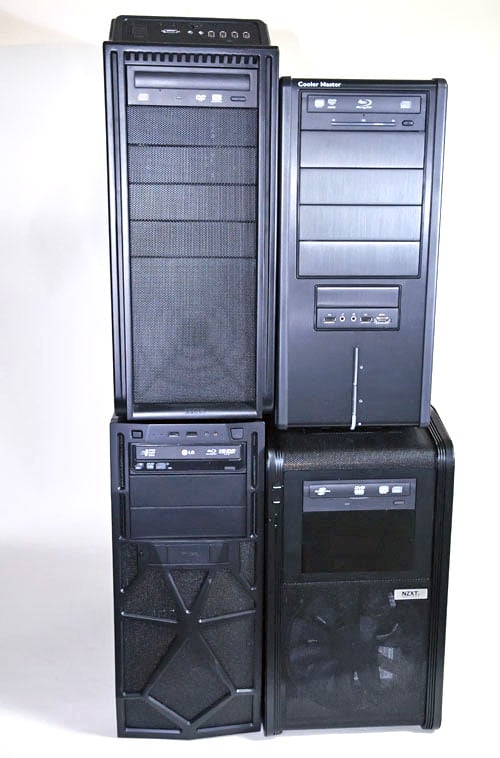
The four midtower cases running in the lab are:
-
Cooler Master Sileo 500. This is Cooler Master’s stab at building a quiet PC case.
-
CM Scout. “CM Storm” is Cooler Master’s “edgy” brand for gamers and LAN party enthusiasts.
-
NZXT Panzerbox. NZXT’s designs are often interesting and flawed. The Panzerbox is less flawed than most.
-
Antec Two Hundred. Antec’s latest gaming chassis, and it’s built for gamers on a budget.
Let’s consider them one at a time...