|
|
| Introduction & Specifications | ||||||||
![]() It was not too long ago that the web was buzzing with dual-core versus quad-core debates. Sides were taken and lines were drawn. At that time, one of the main arguments against quad-core processors was their high asking price. But as time passed and manufacturing refinements were made, costs steadily decreased and quad-cores found their way into the more mainstream market segments. And before you knew it, a price war was imminent. Intel and AMD have been going at one another for years. With AMD unable to compete well at the ultra high-end of the market, however, their focus shifted towards the mainstream market segments. As always, Intel responded and their most recent salvo comes in the form the affordable Core 2 Quad Q8400 processor. Since the Q9400, a 2.66GHz Yorkfield quad-core, was already on the market, why did Intel feel the need to release another, affordable quad-core model? One reason could be to increase yield and utilize dies that would otherwise be discarded. Another reason would be to position another product at the same price point as AMD's. Whatever the case may be, competition is always good for the consumer as it usually drives prices lower and provides more options to choose from. With that in mind, let's take a look at the Intel Core 2 Quad 8400 to see if it's worthy of consideration for your next build...
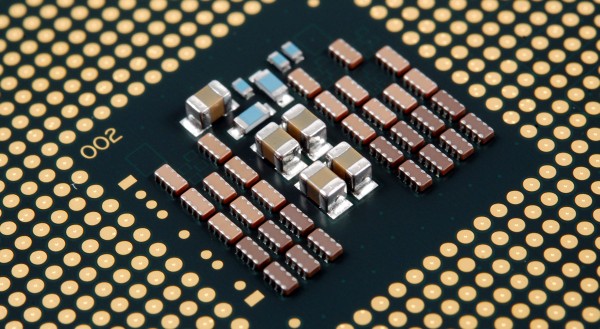
![]() 45nm Yorkfield Quad-Core There isn't a shortage of options for those on the market for a 45nm Intel quad-core CPU. From the 3.2GHz Extreme Edition QX9770 to the 2.33GHz Q8200, Intel has the entire price spectrum covered. Those looking for a low power option can also choose from the S-series processors, which sport lower 65W TDPs. Where exactly does the Q8400 fit in to the mix? Let's find out... |
| Test Setup & SANDRA | |||||||||||||||
How We Configured Our Test Systems: When configuring our test systems for this article, we first entered their respective system BIOSes and set each board to its "Optimized" or "High performance Defaults". We then saved the settings, re-entered the BIOS and set memory timings for either DDR2-1066 with 5,5,5,15 timings or DDR3-1333 with 7,7,7,20 timings. The hard drives were then formatted, and Windows Vista Ultimate was installed. When the Windows installation was complete, we updated the OS, and installed the drivers necessary for our components. Auto-Updating and Windows Defender were then disabled and we installed all of our benchmarking software, defragged the hard drives, and ran all of the tests.
We began our testing with SiSoftware's SANDRA XII, the System ANalyzer, Diagnostic and Reporting Assistant. We ran four of the built-in subsystem tests that partially comprise the SANDRA 2009 suite with Intel's Core 2 Quad Q8400 processor (CPU Arithmetic, CPU Multimedia, Memory Bandwidth, and Cache and Memory). All of the scores reported below were taken with the processor running at its default clock speed of 2.66GHz with 4GB of DDR3-1333 memory.
The Q8400 performed as expected in the SANDRA processor arithmetic and multimedia benchmarks. Our results were very close to SANDRA's Q9450 reference numbers and the chip was outperformed by faster Intel quad-core processors. The memory bandwidth test shows the performance gap between the X48 chipset versus current AMD chipsets, where the on-die memory controller of the AMD platform has the advantage. Of course, Intel saw the discrepancy and integrated the memory controller into the Core i7 processor family. |
| PCMark Vantage | ||||
Next we ran a handful of processors and platforms through Futuremark’s latest system performance metric built especially for Windows Vista, PCMark Vantage. This benchmark suite runs through a host of different usage scenarios to simulate different types of workloads including High Definition TV and movie playback and manipulation, gaming, image editing and manipulation, music compression, communications, and productivity. We like the fact that most of the tests are multi-threaded as well, in order to exploit the additional resources offered by quad-core processors.
|
| LAME MT & Kribibench | ||||||||
In our custom LAME MT MP3 encoding test, we convert a large WAV file to the MP3 format, which is a popular scenario that many end users work with on a day-to-day basis to provide portability and storage of their digital audio content. LAME is an open-source mid to high bit-rate and VBR (variable bit rate) MP3 audio encoder that is used widely around the world in a multitude of third party applications.
In this test, we created our own 223MB WAV file (a hallucinogenically-induced Grateful Dead jam) and converted it to the MP3 format using the multi-thread capable LAME MT application in single and multi-thread modes. Processing times are recorded below, listed in seconds. In this test, shorter times equate to better performance.
A quick look at the results show the benchmark's limitation on the number of threads it uses. At 3.0GHz, the dual-core E6850 posted the fastest times in both single and multi threaded tests. The Q8400 and Q9400 finished with identical times.
For this next batch of tests, we ran Kribibench v1.1, a 3D rendering benchmark produced by the folks at Adept Development. Kribibench is an SSE aware software renderer in which a 3D model is rendered and animated by the host CPU and the average frame rate is reported. We used two of the included models with this benchmark: a "Sponge Explode" model consisting of over 19.2 million polygons and the test suite's "Ultra" model that is comprised of over 16 billion polys.
Unlike LAME MT, Kribibench made use of the Q9400's extra cache as it showed an improvement in performance over the Q8400. The two AMD quads also did a better than the Q8400 by a small margin. |
| Cinebench R10 & 3DMark06 | ||||||||
Cinebench R10 is an OpenGL 3D rendering performance test based on Cinema 4D from Maxon. Cinema 4D is a 3D rendering and animation tool suite used by 3D animation houses and producers like Sony Animation and many others. It's very demanding of system processor resources and is an excellent gauge of pure computational throughput.
This is a multi-threaded, multi-processor aware benchmark that renders a single 3D scene and tracks the length of the entire process. The rate at which each test system was able to render the entire scene is represented in the graph below.
Although the Q9400 held a noticeable advantage in the Kribibench 3D rendering benchmark, we saw that edge disappear in our Cinebench testing. The Q8400 scored very similarly to the Q9400 during multi-threaded runs as both Intel quads performed much better than any of AMD's offerings in this comparison.
3DMark06's built-in CPU test is a multi-threaded DirectX gaming metric that's useful for comparing relative performance between similarly equipped systems. This test consists of two different 3D scenes that are processed with a software renderer that is dependent on the host CPU's performance. Calculations that are normally reserved for your 3D accelerator are instead sent to the CPU for processing and rendering. The frame-rate generated in each test is used to determine the final score.
Once again, Intel's Core 2 Quads pull ahead of the pack in 3DMark's CPU tests. The Q9400 has the best score of the group with the Q8400 right on its heels. |
| Low Res Gaming: Crysis | ||||
For our next set of tests, we moved on to some in-game benchmarking with Crysis. When testing processors with Crysis, we drop the resolution to 800x600, and reduce all of the in-game graphical options to their minimum values to isolate CPU and memory performance as much as possible. However, the in-game effects, which control the level of detail for the games' physics engines and particle systems, are left at their maximum values, since these actually do place some load on the CPU rather than GPU.
![]() The Q8400 falls behind the Q9400 and AMD's 3.1GHz X2 550 in our Crysis benchmarks, but beats the rest of the pack by hitting 129.2 fps. |
| Power Consumption | ||||
We'd like to cover a few final data points before bringing this article to a close. Throughout all of our benchmarking and testing, we monitored how much power our test systems consumed using a power meter. Our goal was to give you all an idea as to how much power each configuration used while idling and while under a heavy workload. Please keep in mind that we were testing total system power consumption at the outlet here, not just the power being drawn by the processors alone.
In a direct comparison to AMD's 2.66GHz quad, the Q8400 uses more juice during both idle and load states. But it did not come as a surprise that the Q9400 needed and additional 5W at idle and 9W during load. |
| Summary & Conclusion | ||||
Performance Summary: Intel's Q8400 is basically a Q9400 with 2MB of L2 cache disabled. This fact was reflected in our tests as we saw the two chips keep pace with one another in almost every benchmark. Against the AMD chips we used for comparison, the competition was also stiff. While the Q9400 was the best of the bunch, the Q8400 definitely held its own. Also, we were very happy with the 3.92GHz overclock we achieved with this chip at only 1.36V.
For about $180, the Q8400 provides enthusiasts with an affordable upgrade option without sacrificing much performance or overclocking ability. There is approximately a $35 difference between the Q8400 and the Q9400. While both run at 2.66GHz, the extra L2 cache on the Q9400 does give it an small edge in performance. If choosing between these two processors, we suggest going with the less expensive Q8400 as the difference between them is imperceptible in real world situations and they should overclock to similar levels. Overall, we like what the Q8400 has to offer. It has mass appeal for being one of the most affordable Intel quad-cores on the market. Enthusiasts on a budget can make use of the processor's overclocking ability, while mainstream builders can save some money by building a Q8400-based and enjoy the benefits of a quad-core powered system for a relatively minimal investment. Those looking to squeeze more life out of their existing socket 775 system with a CPU upgrade should also consider this processor. The Intel Core 2 Quad Q8400 is good value, considering its asking price.
|