|
|
| Intro, Specs, and Related Info | ||||||||||||||||||||||||||||||||||||||||||
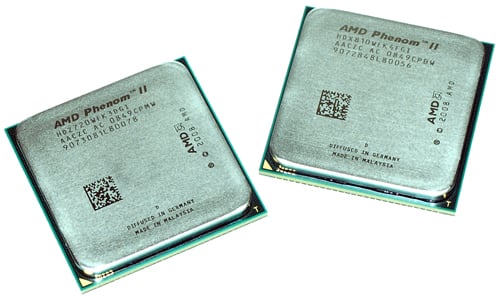
Although the Phenom II X3 720 Black Edition and X4 810 are new additions to AMD's processor line-up, they are part of what AMD has labeled the "Dragon Platform". We have talked about the individual elements of the Dragon platform in a few previous articles here on HotHardware before, so we won't do the same again here. We will, however, recommend taking a look at a few recent articles to get familiar with some of the underlying technologies and components that partially comprise the Dragon platform.
The Enter the Dragon: AMD Phenom II X4 940 article listed above talks about the changes brought forth by AMD's 45nm Phenom II processors. And the various 7-series chipset, Phenom and Athlon processor, and Spider platform related articles cover the remainder of the platform--with the exception of the Phenom II X3 720 Black Edition and X4 810 that is, which we'll be showing you next. |
| Socket AM3: Asus M4A79T Deluxe |
For testing purposes, we thought it would be interesting to take these new Phenom II processors for a spin not only in an existing and proven socket AM2+ platform, but in a brand new DDR3-capable socket AM3 platform as well. To that end, we enlisted the help of Asus who came through with a 790FX-based M4A79T Deluxe. The M4A79T Deluxe is one of Asus' premiere socket AM3-based motherboards. We'll show you the mobo itself in a minute, but first we want to explain what it comes with. Bundled with the M4A79T Deluxe, included in the shiny, reflective green box, we found and assortment of five SATA cables, a case bracket equipped with both USB and Firewire ports, an IDE cable, two CrossFire bridge connectors, a package of Q-Connectors, a custom I/O shield, a driver CD, and of course a user's manual. The Asus M4A79T Deluxe is built around the AMD 790FX / SB750 chipset. It features a dark colored PCB with color coded slots and expansion headers. And un general, the layout of the motherboard is very good with no glaring problems with connector placement or clearance. The M4A79T Deluxe features four, DDR3 DIMM slots supporting up to 16GB of memory, four PCI Express x16 slots (with a flexible lane configuration), and two standard PCI slots. The M4A79T Deluxe also features an 8+2 phase power array design and an elaborate, all copper cooling apparatus that's attached not only to the components in the VRM, but to the 790FX and SB750 chips as well. |
| Our Test Systems and SANDRA | |||||||||||||||||||
How We Configured Our Test Systems: When configuring our test systems for this article, we first entered their respective system BIOSes and set each board to its "Optimized" or "High performance Defaults". We then saved the settings, re-entered the BIOS and set memory timings for either DDR2-1066 with 5,5,5,15 timings or DDR3-1333 with 7,7,7,20 timings. The hard drives were then formatted, and Windows Vista Ultimate was installed. When the Windows installation was complete, we updated the OS, and installed the drivers necessary for our components. Auto-Updating and Windows Defender were then disabled and we installed all of our benchmarking software, defragged the hard drives, and ran all of the tests.
All of the various SANDRA CPU benchmarks we ran reported scores in line with expectations. The new Phenom II X4 810 performs behind the higher-clocked Phenoms IIs and Core 2s, and the Phenom II X3 720 Black Edition comes in a notch behind the X4 810, due to its having one less core. The memory bandwidth tests tell a more interesting story, however. While operating with DDR2-1066 memory, both of these new Phenoms put up peak bandwidth scores as reported by SANDRA of about 12.3 - 12.6GB/s. Replace the DDR2 with DDR3-1333 memory though, and those bandwidth numbers hit a peak about 13.5GB/s. That extra bandwidth should pay some dividends in the more taxing tests in out benchmark suite. |
| PCMark Vantage | ||||
We ran a handful of processors and platforms, including the new Phenom II X4 810 and X3 720, through Futuremark’s latest system performance metric built especially for Windows Vista, PCMark Vantage. PCMark Vantage runs through a host of different usage scenarios to simulate different types of workloads including High Definition TV and movie playback and manipulation, gaming, image editing and manipulation, music compression, communications, and productivity. Most of the tests are multi-threaded as well, so the tests can exploit the additional resources offered by a quad-core CPU.
|
| LAME MT and Kribibench v1.1 | ||||||||
In our custom LAME MT MP3 encoding test, we convert a large WAV file to the MP3 format, which is a popular scenario that many end users work with on a day-to-day basis to provide portability and storage of their digital audio content. LAME is an open-source mid to high bit-rate and VBR (variable bit rate) MP3 audio encoder that is used widely around the world in a multitude of third party applications.
In this test, we created our own 223MB WAV file (a hallucinogenically-induced Grateful Dead jam) and converted it to the MP3 format using the multi-thread capable LAME MT application in single and multi-thread modes. Processing times are recorded below, listed in seconds. Once again, shorter times equate to better performance.
LAME MT can support of maximum of only two threads, hence the X3's strong performance versus the lower-clocked quad-cores here. Once again, the new Phenom II processors perform well, albeit just a bit shy of of the Intel-based competition.
For this next batch of tests, we ran Kribibench v1.1, a 3D rendering benchmark produced by the folks at Adept Development. Kribibench is an SSE aware software renderer in which a 3D model is rendered and animated by the host CPU and the average frame rate is reported. We used two of the included models with this benchmark: a "Sponge Explode" model consisting of over 19.2 million polygons and the test suite's "Ultra" model that is comprised of over 16 billion polys.
|
| Cinebench R10 and 3DMark 06 | ||||||||
|
Cinebench R10 is an OpenGL 3D rendering performance test based on Cinema 4D from Maxon. Cinema 4D is a 3D rendering and animation tool suite used by 3D animation houses and producers like Sony Animation and many others. It's very demanding of system processor resources and is an excellent gauge of pure computational throughput.
This is a multi-threaded, multi-processor aware benchmark that renders a single 3D scene and tracks the length of the entire process. The rate at which each test system was able to render the entire scene is represented in the graph below.
Clock for clock, its clear that the Intel-powered rigs have a distinct advantage in this test. The Phenom IIs perform well though, and again we see the DDR3-powered rigs with a slight edge over their DDR2-based counterparts.
3DMark06's built-in CPU test is a multi-threaded DirectX gaming metric that's useful for comparing relative performance between similarly equipped systems. This test consists of two different 3D scenes that are processed with a software renderer that is dependent on the host CPU's performance. Calculations that are normally reserved for your 3D accelerator are instead sent to the CPU for processing and rendering. The frame-rate generated in each test is used to determine the final score.
All of the quad-core Phenom II's were tightly grouped in the 3DMark6 CPU benchmark; the tri-core X3 trailed the others despite its relatively high frequency because the test is multi-threaded and benefits from that fourth core. The tri-core had no trouble dispatching the much higher clocked Core 2 Duo though. |
| Low Res Gaming: Crysis and FEAR | ||||
For our next set of tests, we moved on to some in-game benchmarking with Crysis and F.E.A.R. When testing processors with Crysis or F.E.A.R., we drop the resolution to 800x600, and reduce all of the in-game graphical options to their minimum values to isolate CPU and memory performance as much as possible. However, the in-game effects, which control the level of detail for the games' physics engines and particle systems, are left at their maximum values, since these actually do place some load on the CPU rather than GPU.
Crysis and F.E.A.R. tell two conflicting stories. In the F.E.A.R. benchmark, the Phenoms has a marked advantage over the Core 2 processors and hung with the much more expensive Core i7. And the exact opposite happened in the Crysis benchmark. Notice the Phenom II X3 720's strong performance, especially when using DDR3 memory. We suspect gamers on a budget are going to really dig the Phenom II X3 720 BE. |
| Total System Power Consumption | ||||
We'd like to cover a few final data points before bringing this article to a close. Throughout all of our benchmarking and testing, we monitored how much power our test systems consumed using a power meter. Our goal was to give you all an idea as to how much power each configuration used while idling and while under a heavy workload. Please keep in mind that we were testing total system power consumption at the outlet here, not just the power being drawn by the processors alone.
These new 45nm Phenom II processors are quite power friendly. While idling, they consumed the least amount of power of the bunch when paired to DDR2 memory. And the same holds true while under load. When using DDR3 memory, the new AM3 processors still consumed relatively little power, but we suspect the Asus motherboard we used didn't completely exploit the C1E power state available in the new Phenoms with its current BIOS, hence the slightly higher power usage. |
| Our Summary and Conclusion | ||||
Performance Summary: The Phenom II X3 720 Black Edition and X4 810 processors performed very well in multiple categories. According to their respective benchmark scores, both processors are competitive with similarly priced offerings from Intel, trading victories depending on the application being tested. Overall though, Intel still has the performance edge clock-for-clock and core-for-core. The X3 720 Black Edition, however, finished well out in front of even a higher-clocked 3.0GHz Core 2 Duo in multi-threaded applications, due to the X3's third processor core. Both the Phenom II X3 720 Black Edition and X4 810 processors were also very good overclockers, and they were quite power friendly as well. Although we showed you only two new Phenom II processors in this article, AMD is announcing immediate availability of the following five new AM3-packaged Phenom II processors today, the Phenom II X4 810, the Phenom II X3 720 Black Edition, and the Phenom II X3 710, at prices of $175, $145, and $125, respectively, in 1K quantities, and the Phenom II X4 910 and Phenom II X4 805 (pricing wasn't available for the X4 910 and X5 805 as of this publication). At these prices, and with the excellent overclockability these processors have shown, we suspect they will be very popular with the enthusiast and gaming communities. The Phenom II X3 720 Black Edition is an especially enticing product. Couple this unlocked processor with an inexpensive 790GX based motherboard and 4GB of DDR2 RAM, and you've for yourself a killer overclocking and gaming platform, for right around $300. That third core in the X3 also offers marked performance benefits over most dual-core CPUs in multi-threaded applications, which is something rather important to consider. These new processors have also proven to run cool and consume less power, relatively speaking, making them well suited to quiet or HTPC system builds too.
|