There is no way to categorize AMD's recent launch of the RV770 graphics processor powering the Radeon HD 4800 series of cards as anything other than a resounding success. Cards based on the GPU hit the scene offering very strong performance in their respective price brackets, and forced rival NVIDIA to react with a quick round of price cuts that will surely eat into NVIDIA's margins on the gigantic 65nm GT200 chip. Although actual sales figures aren't available just yet, we suspect AMD is going to show strong sales of every member of the Radeon HD 4800 series.
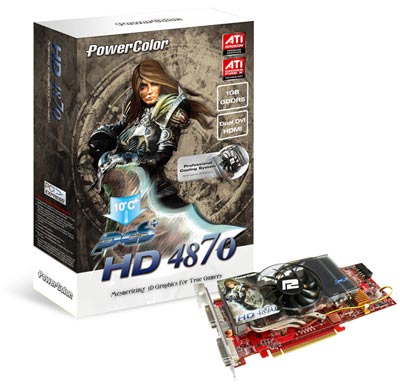
One common concern among analysts and users of AMD's latest flagship GPU has been heat, however. Virtually every evaluation of a reference Radeon HD 4800 series cards makes some mention of the extreme heat radiated by the cards. But PowerColor may have an answer. We recently got a hold of PowerColor's PCS+ HD 4870 card that features a completely redesigned cooler, with multiple heat-pipes and a dense array of aluminum heatsink fins, which the company claims can lower GPU temps by upwards of 10'C. And for good measure, PowerColor also pre-overclocks the cards and packs on 1GB of GDDR5 memory, double that of the initial lot of reference cards.
Considering the relative popularity of the Radeon HD 4870, we were eager to see what this custom variant had in store. Read on to see what PowerColor PCS+ HD 4870 1GB GDDR5 can really do and decide whether it's worth the extra investment...

|
|
|
PowerColor PCS+ HD 4870 1GB GDDR5 |
|
Specifications and Features | |
|
956 million transistors on 55nm fabrication process
PCI Express 2.0 x16 bus interface
256-bit GDDR5
Microsoft DirectX 10.1 support
- ShaderModel 4.1
- 32-bit floating point texture filtering
- Indexed cube map arrays
- Independent blend modes per render target
- Pixel coverage sample masking
- Read/write multi-sample surfaces with shaders
- Gather4 texture fetching
Unified Superscalar Shader Architecture
800 stream processing units
- Dynamic load balancing and resource allocation for vertex, geometry, and pixel shaders
- Common instruction set and texture unit access supported for all types of shaders
- Dedicated branch execution units and texture address processors
128-bit floating point precision for all operations
- Command processor for reduced CPU overhead
- Shader instruction and constant caches
- Up to 160 texture fetches per clock cycle
- Up to 128 textures per pixel
- Fully associative multi-level texture cache design
- DXTC and 3Dc+ texture compression
- High resolution texture support (up to 8192 x 8192)
- Fully associative texture Z/stencil cache designs
- Double-sided hierarchical Z/stencil buffer
- Early Z test, Re-Z, Z Range optimization, and Fast Z Clear
- Lossless Z & stencil compression (up to 128:1)
- Lossless color compression (up to 8:1)
- 8 render targets (MRTs) with anti-aliasing support
- Accelerated physics processing
Dynamic Geometry Acceleration
- High performance vertex cache
- Programmable tessellation unit
- Accelerated geometry shaderpath for geometry amplification
- Memory read/write cache for improved stream output performance
Anti-aliasing features
- Multi-sample anti-aliasing (2, 4, or 8 samples per pixel)
- Up to 24x Custom Filter Anti-Aliasing (CFAA) for improved quality
- Adaptive super-sampling and multi-sampling
- Gamma correct
- Super AA (ATI CrossFireXTMconfigurations only)
- All anti-aliasing features compatible with HDR rendering
Texture filtering features2x/4x/8x/16x high quality adaptive anisotropic filtering modes (up to 128 taps per pixel)
- 128-bit floating point HDR texture filtering
- sRGB filtering (gamma/degamma)
- Percentage Closer Filtering (PCF)
- Depth & stencil texture (DST) format support
- Shared exponent HDR (RGBE 9:9:9:5) texture format support
Integrated AMD Xilleon HDTV encoder
- Provides high quality analog TV output (component/S- video/composite)
- Supports SDTV and HDTV resolutions
- Underscan and overscan compensation
- Seamless integration of pixel shaderswith video in real time
- VGA mode support on all display outputs
OpenGL 2.0 support
ATI CrossFireX Multi-GPU Technology
- Scale up rendering performance and image quality with two, three, or four GPUs
- Integrated compositing engine
- High performance dual channel bridge interconnect
|
ATI Avivo HD Video and Display Platform
Unified Video Decoder 2 (UVD 2) for H.264/AVC, VC-1, and MPEG-2 video formats
- High definition (HD) playback of Blu-ray and HD DVD video
- Dual stream (HD+SD) playback support
- DirectX Video Acceleration 1.0 & 2.0 support
- Support for BD-Live certified applications
- Hardware DivX and MPEG-1 video decode acceleration
- Accelerated video transcoding& encoding for H.264 and MPEG-2 formats
ATI Avivo Video Post Processor
- Color space conversion
- Chroma subsampling format conversion
- Horizontal and vertical scaling
- Gamma correction
- Advanced vector adaptive per-pixel de-interlacing
- De-blocking and noise reduction filtering
- Detail enhancement
- Color vibrance and flesh tone correction
- Inverse telecine (2:2 and 3:2 pull-down correction)
- Bad edit correction
- Enhanced DVD upscaling (SD to HD)
- Automatic dynamic contrast adjustment
Two independent display controllers
- Drive two displays simultaneously with independent resolutions, refresh rates, color controls and video overlays for each display
- Full 30-bit display processing
- Programmable piecewise linear gamma correction, color correction, and color space conversion
- Spatial/temporal dithering provides 30-bit color quality on 24-bit and 18-bit displays
- High quality pre- and post-scaling engines, with underscan support for all display outputs
- Content-adaptive de-flicker filtering for interlaced displays
- Fast, glitch-free mode switching
- Hardware cursor
Two integrated dual-link DVI display outputs
- Each supports 18-, 24-, and 30-bit digital displays at all resolutions up to 1920x1200 (single-link DVI) or 2560x1600 (dual-link DVI)2
- Each includes a dual-link HDCP encoder with on-chip key storage for high resolution playback of protected content
Two integrated 400 MHz 30-bit RAMDACs
- Each supports analog displays connected by VGA at all resolutions up to 2048x1536
HDMI output support
- All display resolutions up to 1920x1080
- Integrated HD audio controller with support for stereo and multi-channel (up to 7.1) audio formats, including AC-3, AAC, DTS, DTS-HD & Dolby True- HD4, enabling a plug-and-play audio solution over HDMI
ATI PowerPlay Technology
- Advanced power management technology for optimal performance and power savings
- Performance-on-Demand
- Constantly monitors GPU activity, dynamically adjusting clocks and voltage based on user scenario
- Clock and memory speed throttling
- Voltage switching
- Dynamic clock gating
- Central thermal management – on-chip sensor monitors GPU temperature and triggers thermal actions as required
|
PowerColor PCS+ HD 4870 1GB GDDR5 Box and Bundle
Although the card itself is anything but ordinary, PowerColor bundles a relatively basic assortment of accessories and software with the PCS+ HD 4870. Along with the card, we found a simple installation guide, a driver disc, a CrossFire bridge connector, a DVI to HDMI adapter, a DVI to VGA adapter, an HD component output dongle, and an S-Video to composite video adapter. No power adapters, additional software, games or applications were included.






;)
;)