|
|
| Introduction and Features |
If you've been on top of the PC scene for any length of time, you probably know that whether by choice or necessity, AMD has taken a different tact as of late. Whereas the company was all about bigger, faster, and better during the Athlon's heyday, AMD is now more about touting the performance per dollar and value of their products. While they may not have a CPU with the horsepower to compete in the benchmark war with Intel's $1000 behemoths, AMD's affordably priced Phenoms do offer good bang for the buck.
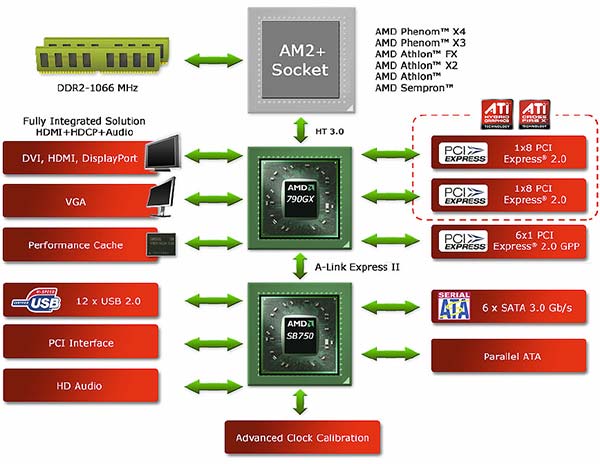
The AMD 790GX is manufactured at 55nm and features an Integrated Radeon HD 3300 Graphics Processor (IGP) that integrates a DirectX10 compliant Shader Model 4.0 graphics core, a Unified Video Decoder (UVD), two x8 PCI Express 2.0 links or 1 x16 link, HyperTransport 3.0, DVI / HDMI interface, and internal / external TMDS and DisplayPort capability in a single chip. The graphics core is actually identical to the one found in the 780G, but in the 790GX, it is clocked much higher (700MHz) for up to 33% better performance, PowerPlay features have been enahnced to support lower power states, and many boards featuring the 790GX will be equipped with dedicated sideport memory, for increased performance. Of course, the 790GX supports ATI Hybrid CrossFire technology as well, for increased performance or low-power operation.
The AMD SB750 Southbridge communicates with the Northbridge through the A-Link Express II interface. The AMD SB750 offers support for both SATA RAID and IDE drives and it is the key piece in the Advanced Clock Calibration puzzle. In total, the SB750 supports 6x SATA 3.0 Gb/s ports that can be setup in IDE, AHCI, JBOD, RAID 0, RAID 1, RAID 5 or RAID 10 modes, 12x USB 2.0 and 2x USB 1.1 ports, DASH 1.0, 6x PCI slots, HD Audio, IDE, and Serial and Parallel ports. |
| The Gigabyte MA790GP-DS4H & Overclocking |
To evaluate the new AMD 790GX chipset, we got out hands on a retail ready motherboard from Gigabyte, the MA790GP-DS4H.
|
| Our Test Systems and SANDRA | |||||||||||||||||
How We Configured Our Test Systems: When configuring our test systems for this article, we first entered their respective system BIOSes and set each board to its "Optimized" or "High performance Defaults". We then saved the settings, re-entered the BIOS and set memory timings for either DDR2-1066 (AMD) with 5,5,5,15 timings or DDR3-1333 with 7,7,7,20 timings (Intel). The hard drives were then formatted, and Windows Vista Ultimate was installed. When the Windows installation was complete, we updated the OS, and installed the drivers necessary for our components. Auto-Updating and Windows Defender were then disabled and we installed all of our benchmarking software, defragged the hard drives, and ran all of the tests.
System 1: Asus P5E3 Premium Intel G45PID GeForce 8800 GTX WD740 "Raptor" HD Windows Vista Ultimate System 2: Asus M3N-HT Deluxe Gigabyte GA-MA790GP-DDS4H On-Board Ethernet WD740 "Raptor" HD Windows Vista Ultimate
Our Phenom X4 9850 processor performed as expected in the three SiSoft SANDRA benchmark modules that we ran. CPU arithmetic and multimedia performance was right on par with the reference data, and memory bandwidth peaked at over 9.5GB/s. |
| PCMark Vantage | ||||
We also ran the 790GX-based Gigabyte MA790GP-DS4H motherboard through Futuremark’s latest system performance metric built especially for Windows Vista, PCMark Vantage. PCMark Vantage runs through a host of different usage scenarios to simulate different types of workloads including High Definition TV and movie playback and manipulation, gaming, image editing and manipulation, music compression, communications, and productivity. Most of the tests are multi-threaded, so they can exploit the additional resources offered by a quad-core CPU.
|
| Lame MT and Kribibench | ||||||||
In our custom LAME MT MP3 encoding test, we convert a large WAV file to the MP3 format, which is a popular scenario that many end users work with on a day-to-day basis to provide portability and storage of their digital audio content. LAME is an open-source mid to high bit-rate and VBR (variable bit rate) MP3 audio encoder that is used widely around the world in a multitude of third party applications.
For this next batch of tests, we ran Kribibench v1.1, a 3D rendering benchmark produced by the folks at Adept Development. Kribibench is an SSE aware software renderer where a 3D model is rendered and animated by the host CPU and the average frame rate is reported. We used two of the included models with this benchmark: a "Sponge Explode" model consisting of over 19.2 million polygons and the test suite's "Ultra" model that is comprised of over 16 billion polys.
The Kribibench tests we ran also put the 790GX in a positive light. AMD's new chipset just edged past the nForce 780a and almost hit the mark set by the 790FX. |
| Cinebench R10 and 3DMark06 | ||||||||
Cinebench R10 is an OpenGL 3D rendering performance test based on Cinema 4D. Cinema 4D from Maxon is a 3D rendering and animation tool suite used by 3D animation houses and producers like Sony Animation and many others. It's very demanding of system processor resources and is an excellent gauge of pure computational throughput.
Cinebench didn't seem to play perfectly well with the 790GX. In the single threaded test, the 790GX actually finished about 10% behind the 780a and 790FX--and this was a repeatable result. The new 790GX, however, managed to come back in the multi-threaded test to finish right in between the 780a and 790FX.
3DMark06's built-in CPU test is a multi-threaded DirectX gaming metric that's useful for comparing relative performance between similarly equipped systems. This test consists of two different 3D scenes that are processed with a software renderer that is dependent on the host CPU's performance. Calculations that are normally reserved for your 3D accelerator are instead sent to the CPU for processing and rendering. The frame-rate generated in each test is used to determine the final score.
3DMark06's built-in CPU benchmark put the AMD 790GX just behind the nForce 780a and 790FX. The 26 - 96 point deltas, however, equate to a maximum difference of only 2.8%. |
| Gaming: Crysis and F.E.A.R. | ||||
For our next set of tests, we moved on to some in-game benchmarking with Crysis and F.E.A.R. When testing motherboards or processors with Crysis or F.E.A.R., we drop the resolution to 800x600, and reduce all of the in-game graphical options to their minimum values to isolate CPU and memory performance as much as possible. However, the in-game effects, which control the level of detail for the games' physics engines and particle systems, are left at their maximum values, since these actually do place some load on the CPU rather than GPU.
Our low-resolution in-game testing speak to one of the main strengthes of the AMD 790GX chipset--its relatively powerful IGP. In both our F.E.A.R. and Crysis benchmarks, the 790GX blows the competition from NVIDIA and Intel right out of the water. The AMD 790GX's performance in our in-game tests was simply on another level in comparison to competing IGPs. |
| Video Playback Performance | ||||
We also did some quick testing of the AMD 790GX's video processing engine as it is implemented on the Gigabyte MA790GP-DS4H, in terms of both image quality and CPU utilization with some HQV and H.264 playback tests.
|
| Power Consumption | ||||
Before we bring this article to a close, we'd like to cover a few final data points. Throughout all of our benchmarking and testing, we monitored how much power our test systems were consuming using a power meter. Our goal was to give you all an idea as to how much power each configuration used while idling and under a heavy workload. Please keep in mind that we were testing total system power consumption at the outlet here, not just the power being drawn by the motherboards alone.
|
| Our Summary and Conclusion | ||||
Performance Summary: AMD's new 790GX chipset proved to be a solid performer throughout our entire battery of benchmarks. In all of the more processor and memory bound tests, the 790GX performed on-par with or slightly ahead of NVIDIA's nForce 780a chipset and just behind AMD's own 790FX. In terms of IGP performance, the 790GX outperformed offerings from both Intel and NVIDIA in both in-game benchmarks that we ran and by a very large margin.
The combination of AMD's new 790GX Northbridge and SB750 Southbridge result in the most well rounded and feature-rich chipset for the AMD platform released to date. The platform should appeal to cost conscious consumers due to its strong performance, excellent IGP, and relatively affordable $150 (give or take) price point. Casual gamers can get by with just the 790GX's IGP or add a low-end discreet Radeon to the equation for somewhat better gaming performance through the use of CrossFireX. And hardcore AMD enthusiasts will no doubt be intrigued by the platform's SB750 Southbridge with Advanced Clock Calibration (ACC), which enhances the overclocking potential of Phenom processors, not to mention the chipset's full support for dual graphics configurations, even if each PEG slot features only 8 PCI Express lanes. We should note that the SB750, however, won't be exclusive to the 790GX. A new wave of 790FX motherboards featuring the SB750 should arrive in the not too distant future as well, which will also support ACC.
|