|
|
| Introduction and Specifications | ||||
Before we get down to the technical nitty gritty, you'll notice NVIDIA has a new naming convention for these cards. GeForce GTX denotes the current high end, with the model number afterward its performance level in relation to other cards in the same family. Our GeForce 8800 GTX launch article goes in depth on the G80 GPU architecture and explains NVIDIA's CUDA GPGPU technology. Also, our GeForce 8800 GT, 8800 GTS 512MB, 9800 GTX and GX2 pieces encompass the majority of our G92 GPU coverage. |
| The GeForce GTX 280 and 260 |
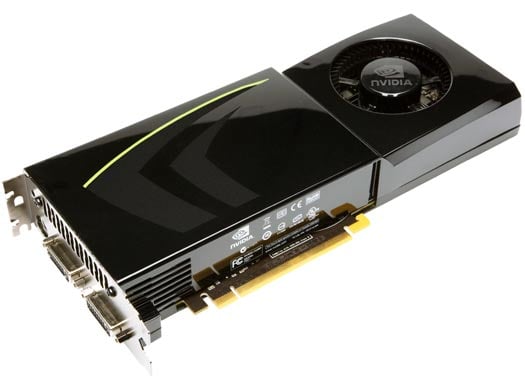
The actual GeForce GTX 280 and GTX 260 cards don't look much different than current GeForce 9800 GTX and GX2 cards, due to the shells surrounding the cards. The GeForce GTX 280 reference card picutred here has a GPU clock of 602MHz, with a Stream Processor clock of a1,296MHz. The full 240 SP cores in the GT200 GPU are enabled, and the card sports a 1GB frame buffer consisting of 16 pieces of DDR3 memory clocked at 1.1GHz (2.2GHz DDR), connected via a 512-bit memory interface. This configuration offers a peak texturing fillrate of a 48.2GTexels/s and over 141GB/s of memory bandwidth. As we've mentioned, the new GeForce GTX 260 is essentially the same as the GTX 280, sans a couple of thread processor clusters and memory partitions. The GT200 GPU used on the GTX 260 has 192 stream processors enabled. The GPU is clocked at 576MHz on the reference card, with a 1,242MHz stream processor clock. 866MB of on-board DDR3 frame buffer memory is clocked at 999MHz (1.99GHz DDR), connected to the GPU over a 448-bit interface. The GeForce GTX 260 offers a peak texturing fillrate of 36.9GTexels/s with 111.9GB/s of memory bandwidth. |
| Retail-Ready ASUS and EVGA GTXes |
For the purpose of this review, we got our hands on a couple of retail-ready GeForce GTX 280 cards for testing. A third card we used for 3-way SLI was an engineering sample provided by NVIDIA, as was the GeForce GTX 260. With the exception of the complex graphics affixed to the card's outer shell, EVGA's GeForce GTX 280 is physically identical to NVIDIA's reference design. EVGA, however, chose to up the card's default GPU and memory clocks. Whereas NVIDIA's reference design calls for a 602MHz GPU clock with 1.1GHz memory, EVGA has configured their FTW Edition card with a 670MHz GPU and 1.21GHz memory. The frame buffer size is 1GB, and all outputs and connected are identical to the reference design. The Asus ENGTX280 TOP was also based on NVIDIA's reference design, and also had a 670MHz GPU clock with 1.21GHz memory. The card is emblazoned with pink, purple, and brown camouflage, with a warrior chic smack dab in the center. ASUS too bundles in the usual assortment of goodies with the ENGTX280 TOP, including driver and utility discs, a user's guide, a dual-Molex to 6-pin PCI Express power adapter, a DVI to VGA adapter, an HD component output dongle, and a "pleather" CD / DVD case, with matching mouse pad. |
| The GPU - Not Just For Games |
Much of NVIDIA's recent marketing has centered around the notion that GPUs aren't just for gaming any longer, which you'd expect considering they've got a GPU architecture in their arsenal capable of 933 GFlops. Of course, we've known this to be true for quite some time, but there definitely seems to be more happening in the GPGPU arena as of late. During our briefing for the GeForce GTX 200 series architecture, for example, NVIDIA showed off a number of applications that all benefited from the power of a GPU, and none of them were games.
Many other types of complex mathematical calculations are also well suited to GPU acceleration. To further demonstrate, we enlisted the help of a small application dubbed "GPUQuant" that performs Black & Scholes or Monte Carlo calculations on either a CPU or GPU. The results above speak for themselves. The new GeForce GTX 200 series architecture offers significantly more compute performance than any existing CPU or GPU for this type of calculation. We should point out, however, this application was NOT multi-threaded when running on a CPU, so theoretically similar calculations could perform at approximately 4x the rate shown above on a quad-core CPU, but even then it would still offer only a fraction of the throughput of the GPUs. |
| Our Test Systems and 3DMark06 | ||||||||||||
HOW WE CONFIGURED THE TEST SYSTEMS: We tested all of the graphics cards used in this article on either an Asus nForce 790i SLI Ultra based Striker II Extreme motherboard (NVIDIA GPUs) or an X48 based Asus P5E3 Premium (ATI GPUs) powered by a Core 2 Extreme QX6850 quad-core processor and 2GB of low-latency Corsair RAM. The first thing we did when configuring these test systems was enter their respective BIOSes and set all values to their "optimized" or "high performance" default settings. Then we manually configured the memory timings and disabled any integrated peripherals that wouldn't be put to use. The hard drive was then formatted, and Windows Vista Ultimate was installed. When the installation was complete we fully updated the OS, and installed the latest DX10 redist and various hotfixes, along with the necessary drivers and applications.
3DMark06's overall score from the default benchmark test doesn't tell use very much, mostly because it is CPU bound - even with a Core 2 Extreme QX6850 at the heart of our test system. The new GeForce GTX 260 puts up a score well ahead of the 9800 GTX, but behind the GX2 and Radeon HD 3870 X2. The GTX 280 fares better but is still limited due to the CPU bound circumstance of this test.
3DMark06's individual Shader Model tests tell essentially the same story. The new GeForce GTX 260 and GTX 280 put up scores measurably better than any other single GPU, but the differences aren't very significant. Thankfully, we can now retire 3DMark06, because Futuremark's latest version, 3DMark Vantage, has hit the scene. |
| Futuremark 3DMark Vantage | ||||||
As the graph above show, results generated with 3DMark Vantage's Extreme preset testing option produce much more diverse results than the again 3DMark06. According the 3DMark Vantage, the GeForce GTX 280 is easily the most powerful graphics card we tested. The GeForce GTX 260 also surpassed all other singe-GPU powered cards, but it wasn't quite on the level of the dual-GPU powered GeForce 9800 GX2. Vantage also shows the excellent multi-GPU scaling offered by the NVIDIA powered cards - the quad-SLI and two- and three-way SLI GeForce GTX 280 setups simply crush the competition. Please note, however, the Radeon HD 3870 X2 CrossFireX configuration had scaling issues with the Catalyst 8.5 drivers. Future driver revisions should help its score here significantly.
3DMark Vantage's individual GPU tests also demonstrate the excellent performance of the GeForce GTX 280 and 260. Once again, both cards were clearly superior to any other single-GPU powered configuration and the GTX 280 was faster than all of the dual-GPU setups as well. Standard SLI and 3-Way SLI with the ASUS and EVGA cards we tested also showed excellent scaling here, producing results that were leaps and bounds ahead of anything else. |
| Half Life 2: Episode 2 | ||||||
Our custom Half Life 2: Episode 2 benchmark corroborates what 3DMark Vantage told us on the previous page, for the most part. Here, the GeForce GTX 280 and GTX 260 are clearly superior to any other single-GPU out there. The GTX 280 also outperformed the dual-GPU setups represented here, and even managed to outpace the 3-way 9800 GTX SLI and dual-9800 GX2 quad-SLI rigs at the lower resolution. |
| Unreal Tournament 3 | ||||||
We saw more of the same with Unreal Tournament 3. In this game, most of the high-end cards produce somewhat similar results at 1,920 x 1,200, with only the GeForce 9800 GTX trailing considerably. At 2,560 x 1,600, however, the deltas get larger and the GeForce GTX 280 and GTX 260 show their mettle. The GTX 280 was once again the fastest of the single-GPU powered card. It wasn't quite as fast as a 9800 GTX SLI setup, however. And scaling with standard SLI and 3-way GTX 280 SLI looked much like HL2:EP2 - because the test is CPU bound with that much GPU horsepower in the system, performance doesn't increase all that much, if at all. |
| Enemy Territory: Quake Wars | ||||||
The new GeForce GTX 280 and GTX 260 performed very well in our custom Enemy Territory: Quake Wars test. Once again, both cards were clearly superior than any other single-GPU based product we tested. The GeForce GTX 280 was faster than all of the dual-GPU setups as well; it took the 3-way GeForce 9800 GTX and dual-GeForce 9800 GX2 quad-SLI rigs to take it down. Scaling in a two card GeForce GTX 280 SLI configuration was also quite good. But 3-way GTX 280 SLI was limited at 1,920 x 1,200. At 2,560 x 1,600, 3-way offered up the best performance of the bunch, but it was only slightly faster then the two-card setup. |
| Crysis Performance | ||||||
Crysis tells essentially the same story as all of our previous in-game tests. Here, the new GeForce GTX 280 and GTX 260 best all other single-GPU based rigs. They both fall victim to the GX2 and 9800 GTX SLI setups, however. Multi-GPU scaling with Crysis was also good with the new GeForce GTX 280, putting up scores far superior to anything else we've ever tested. 3-way SLI, however, didn't offer up much of an improvement over two cards, at least not with our quad-core powered test system and the current 177 series drivers. |
| Video Quality and Performance | ||||
We also did some quick testing of the GeForce GTX 280's video processing engine, in terms of both image quality and CPU utilization with some HQV and H.264 playback tests.
HQV is comprised of a sampling of SD video clips and test patterns that have been specifically designed to evaluate a variety of interlaced video signal processing tasks, including decoding, de-interlacing, motion correction, noise reduction, film cadence detection, and detail enhancement. As each clip is played, the viewer is required to "score" the image based on a predetermined set of criteria. The numbers listed below are the sum of the scores for each section. We played the HQV DVD using the latest version of Cyberlink's PowerDVD HD, with hardware acceleration for AMD AVIVO HD and NVIDIA PureVideo HD extensions enabled.
Next we conducted a test using an H.264 encoded movie trailer clip for "Beowulf" which is available for download on Apple's QuickTime HD website. The CPU utilization data gathered during these tests was taken from Windows Vista's built-in Performance Monitor. The graphs show the CPU utilization for a GeForce 9800 GX2 and a Radeon HD 3870 X2 using PowerDVD HD to playback the QuickTime clip.
With a fast quad-core processor powering our test system and an unencrypted HD video clip being played back, all of the cards we tested had low CPU utilization in this test. The GTX 280 didn't fair quite as well as the GX2, however, which is confusing because they both sport the same video engine. Perhaps with future drivers, the GTX 280's performance here will improve a bit. We should note that with hardware acceleration disabled, playing this video clip results in about 12% - 15% average CPU utilization, so there is a marked improvement with both PureVideo HD and UVD. Also note that with encoded content, like an off the shelf Blu-Ray disc for example, CPU utilization will be measurably higher that what you see here. However, both platforms should have no trouble playing back high def digital video. |
| Power Consumption and Noise | ||||
We'd like to cover a few final data points before bringing this article to a close. Throughout all of our benchmarking and testing, we monitored how much power our test systems were consuming using a power meter. Our goal was to give you all an idea as to how much power each configuration used while idling and under a heavy workload. Please keep in mind that we were testing total system power consumption at the outlet here, not just the power being drawn by the motherboards alone.
As you can see, the GeForce GTX 280 and GTX 260 fare very well in the power consumption department while idling, with both cards consuming the least amount of power. Tax them with a heavy workload, however, and power consumption goes way up. The GTX 260, for example, consumed 31 more watts than a 9800 GTX under load, and the GTX 280 used over 100 more watts. Start doubling, or tripling up on the GTX 280s, and consumption hits insane levels. The standard SLI and 3-way GeForce GTX 280 configuration consumed more power than any other graphics setup we have tested to day. |
| Our Summary and Conclusion | ||||
Performance Summary: Summarizing the performance of NVIDIA's new GeForce GTX 280 and GeForce GTX 260 cards is quite easy. The GeForce GTX 260's overall performance falls somewhere in between the single-GPU based GeForce 9800 GTX and dual-GPU powered GeForce 9800 GX2, and it is usually faster than the dual-GPU powered Radeon HD 3870 X2 as well. The flagship GeForce GTX 280, however, was overall the fastest single graphics card we have ever tested. There were a couple of instances when the GeForce 9800 GX2 pulled ahead of the GTX 280, but in the vast majority of our testing, no other single graphics card could match the performance of the GeForce GTX 280. NVIDIA has done it again and raised the bar for that can be considered an ultra high-end GPU. The GT200 series GPU at the heart of the GeForce GTX 280 and GeForce GTX 260 offers more brute force performance than anything else to come before it. Though producing such a massive GPU, does have its drawbacks, which are evident when you consider its die size and when looking at power consumption characteristics, the fact remains NVIDIA has produced the most powerful and fastest graphics card we have ever tested - yet again.
|