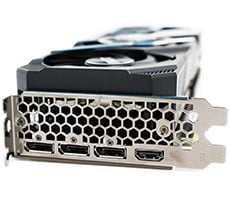
PNY XLR8 GeForce 8800 GTS 512MB PCIe 2.0 Graphics Card


Late last year, NVIDIA released a pair of new 8800-series graphics cards based on their G92 GPU. The new cards were designed to keep NVIDIA's products at the top of the food chain at their respective price points, while also being a bit more affordable. The first of the two was the GeForce 8800 GT. It brought high-end performance to the mainstream crowd mostly due to its 112 stream processor configuration and 65m G92 GPU. The G92's shrink to 65nm from TSMC's 90nm process used with the G80, brings with it lower power usage, but also lower prices due to a reduced die size, enabling NVIDIA to set the MSRP for the 8800 GT in the range of $200-250.
One thing we noticed in the launch piece for the 8800 GT was the odd number of stream processors enabled in the GPU. We explained the 8800 GT's 112 stream processor configuration by pointing out that there were only 7 groups of SPs enabled, rather than the 8 used in the G80, and speculated another cluster of unused SPs was lurking inside the GPU. Then a month later, the 8800 GTS was refreshed and our suspicions were proved true. The new 8800 GTS 512 has more in common with the 8800 GT than the previous cards in the 8800-series because of its new PCB design and the G92 as its core, but with the newly refreshed GTS all 8 groups of stream processors were enabled, for a grand total of 128. Rather than offering 320MB and 640MB frame buffers though, the new 8800 GTS 512, as its name suggests, comes with 512MB of memory due to its 256-bit memory interface. Core and memory clock speeds were also raised as well to keep fill rate and bandwidth as high as possible. And today we're going to look at an 8800 GTS 512 in full retail trim courtesy of PNY Technologies.

|
|
|

| Fabrication: 65nm Number of Transistors: 754 Million Core Clock (Includes dispatch, texture units and ROPs): 650MHz Shader Clock (Stream Processors): 1.625GHz Stream Processors: 128 Memory Clock: 970MHz (1940 DDR) Memory Interface: 256-bit Memory Bandwidth: 62 GB/ps Frame Buffer Size: 512 MB ROPs: 16 HDCP Support: Yes HDMI Support: Yes Connectors: 2xDual-Link DVI-I 7-Pin TV Out RAMDACS: 400MHz Bus Technology: PCI Express 2.0 Max Board Power: 150 Watts NVIDIA unified architecture: Fully unified shader core dynamically allocates processing power to geometry, vertex, physics, or pixel shading operations, delivering up to 2x the gaming performance of prior generation GPUs. Full Microsoft DirectX 10 Support: World's first DirectX 10 GPU with full Shader Model 4.0 support delivers unparalleled levels of graphics realism and film-quality effects. NVIDIA SLI Technology: Delivers up to 2x the performance of a single graphics card configuration for unequaled gaming experiences by allowing two cards to run in parallel. The must-have feature for performance PCI Express graphics, SLI dramatically scales performance on today's hottest games. NVIDIA Lumenex Engine: Delivers stunning image quality and floating point accuracy at ultra-fast frame rates. 16x Anti-aliasing: Lightning fast, high-quality anti-aliasing at up to 16x sample rates obliterates jagged edges. 128-bit floating point High Dynamic-Range (HDR): Twice the precision of prior generations for incredibly realistic lighting effects - now with support for anti-aliasing. NVIDIA Quantum Effects Technology: Advanced shader processors architected for physics computation enable a new level of physics effects to be simulated and rendered on the GPU - all while freeing the CPU to run the game engine and AI. |
NVIDIA nView Multi-Display Technology: Advanced technology provides the ultimate in viewing flexibility and control for multiple monitors. Dual 400MHz RAMDACs: Blazing-fast RAMDACs support dual QXGA displays with ultra-high, ergonomic refresh rates - up to 2048x1536@85Hz. Dual Dual-link DVI Support: Able to drive the industry's largest and highest resolution flat-panel displays up to 2560x1600. NVIDIA PureVideo HD Technology: The combination of high-definition video decode acceleration and post-processing that delivers unprecedented picture clarity, smooth video, accurate color, and precise image scaling for movies and video. Discrete, Programmable Video Processor: NVIDIA PureVideo HD is a discrete programmable processing core in NVIDIA GPUs that provides superb picture quality and ultra-smooth movies with low CPU utilization and power. Hardware Decode Acceleration: Provides ultra-smooth playback of H.264, VC-1, WMV and MPEG-2 HD and SD movies. HDCP Capable: Designed to meet the output protection management (HDCP) and security specifications of the Blu-ray Disc and HD DVD formats, allowing the playback of encrypted movie content on PCs when connected to HDCP-compliant displays. Spatial-Temporal De-Interlacing: Sharpens HD and standard definition interlaced content on progressive displays, delivering a crisp, clear picture that rivals high-end home-theater systems. High-Quality Scaling: Enlarges lower resolution movies and videos to HDTV resolutions, up to 1080i, while maintaining a clear, clean image. Also provides downscaling of videos, including high-definition, while preserving image detail. Inverse Telecine (3:2 & 2:2 Pulldown Correction): Recovers original film images from films-converted-to-video (DVDs, 1080i HD content), providing more accurate movie playback and superior picture quality. Bad Edit Correction: When videos are edited after they have been converted from 24 to 25 or 30 frames, the edits can disrupt the normal 3:2 or 2:2 pulldown cadences. PureVideo HD uses advanced processing techniques to detect poor edits, recover the original content, and display perfect picture detail frame after frame for smooth, natural looking video. Video Color Correction: NVIDIA's Color Correction Controls, such as Brightness, Contrast and Gamma Correction let you compensate for the different color characteristics of various RGB monitors and TVs ensuring movies are not too dark, overly bright, or washed out regardless of the video format or display type. Integrated SD and HD TV Output: Provides world-class TV-out functionality via Composite, S-Video, Component, or DVI connections. Supports resolutions up to 1080p depending on connection type and TV capability. Noise Reduction: Improves movie image quality by removing unwanted artifacts. Edge Enhancement: Sharpens movie images by providing higher contrast around lines and objects. |
;)
;)
The PNY GeForce 8800 GTS 512 comes in a tame (by today's standards) black box with green and blue highlights. A large red badge at one corner clearly states that this card is made for PCI Express compliant motherboards, a warning that probably is a bit outdated in that almost all enthusiast-class cards released in the past few years have been PCI-e based. What is missing from the note is that the 8800 GTS 512 (and 8800 GT) are both PCI-E 2.0 compliant boards. The 8800 GTS 512 will run in PCI Express 1.0 slots as well, however, so don't throw out those older motherboards just yet.;)
In lieu of any other graphics is a script "XLR8", marking this card as part of PNY's XLR8 performance series of hardware, which includes everything from memory to graphics cards and even Flash drives. Similar to what we had reported with the Sapphire Atomic HD 3870, PNY has their own gaming oriented website, where they advertise tournaments and other events, as well as their products, of course.