|
|
| Welcome! Come one, Come All! |
|
Each year our Holiday Buyer's Guide is a little different. For example, this year we've decided to break the things down by component type. Within each category we've broken down our suggestions into three price ranges: High-end, middle of the road, and shoe-string budget. This will help you quickly and easily select the types of parts you want, without sifting through a bunch of components you may not be interested in.On the other hand, if you want to buy a completely new system, we have included complete system breakdowns on the last page that are based on the components in this guide. This should let you easily create a list of the parts to build a complete rig if you so choose. Our High-end system isn't exactly a money-is-no-object type rig, but it does represent the best-of-breed components from each category without total disregard for price/performance ratios. We've been good all year in an attempt to get at least one or two of these components under our Christmas tree, but we'll have to wait a few more weeks to find out if we've made the cut. For those who want a lot of bang for the buck, you're also in luck. We've offered up a myriad of mid-range components that, if assembled together, represent a lot of performance for a price range between $1250 and $1750. And if you want a little more performance, you could buy a few high-end parts if you like and/or overclock the system, of course. These components probably represent the best value for your money, especially when it comes to longevity. For those of us who are on a more limited budget, our value-priced component recommendations would result in a sub-$750 computer that is still more than capable of running the latest software and games - just don't expect to run some recent titles at high resolution with anti-aliasing and and other image quality settings cranked up too high.Thanks to the latest advances in processors, memory and video cards, it is possible to put together a computer that even the crabby Scrooge himself would agree is a bargain. This system may not be as forward-looking as the middle of the road system, but if you have a few extra dollars you could upgrade some of the parts to mid-level components and breathe a bit more life into the rig. |
| At The Core: Processors |
|
At the high end there is the brand-spanking-new Intel Penryn QX9650. What's not to like about this CPU, except for its price perhaps? It supports SSE4, has a total of 12MB of shared L2 cache, and four lightening fast cores that make this CPU the current king of the hill. The bottom line is that this thing is the fastest consumer CPU on the market right now and there's nothing out there that can touch it. The Core 2 Extreme QX9770 is waiting in the wings, but that puppy won't hit store shelves until well after the holiday. If you want the fastest CPU possible this holiday season, the Intel Core 2 Extreme QX9650 is it. We have been waiting for the AMD Phenom line of processors for quite some time and it's finally here and available for purchase. Currently, there are only two models available and we've chosen the 2.3 GHz 9600 as our high-end AMD pick mostly because it's 100 MHz faster than the 9500. Regardless of its seemingly low 2.3GHz clock speed, this native quad-core CPU is plenty powerful for today's applications and is AMD's current king of the hill. When running multi-threaded applications, the Phenom 9600 handily outpaces even the fastest Athlon 64 X2 processors; unfortunately it won't quite keep up with a quad-core Intel processor at similar clock speeds, like the Q6600 we've listed below for $270. If you're an AMD fan and don't do a lot of heavy multi-tasking, then we suggest the 6400+ Black Edition. It's reasonably priced, offers great performance in everything but the most heavily multi-threaded applications and perhaps best of all, you won't have to refinance your home just to buy one. The 6400+ is an unlocked 3.2 GHz dual core CPU with two 1 MB L2 caches. Being unlocked means that this CPU is extremely easy to overclock if you have the right board and cooling. You could potentially squeeze a lot more performance out of this CPU, if you know what you're doing. If you need any help overclocking, always feel free to visit our overclocking forum section and ask for a hand. The 6400+ is fast, easy to overclock, and runs relatively cool given its performance characteristics. In fact, the only downside we see to this CPU is that the future of AMD is all about the Phenom. If you like to multi-task and are hot for an AMD quad-core processor, then let's look at the "other" Phenom, the 9500. It runs at 2.2 GHz, but don't let that fool you, it's still much faster than all but the very fastest of the Athlon 64 X2s at most tasks, and is second only to its faster brother, the 9600, for multi-tasking in the AMD camp. The new Phenoms have 512 KB level 2 cache per core, and a 2 MB L3 cache shared between the cores. The extra cache along with other improvements help the Phenom outpace their Athlon 64 X2 counterparts on a clock for clock basis. If you're a multi-tasker craving an Intel quad-core, but can't afford the high-end Core 2 Extreme, then the Q6600 is a great choice. With 4 cores running at 2.4 GHz it offers a great balance of multi-thread and single-thread performance. It's a great option for anyone looking to have great performance in just about any application without having to spend your retirement money. We wish that Intel had released new Yorkfield-based CPUs at slower speed grades in time for the holidays, but this CPU is still a stellar performer for the money. Sticking with Intel for moment, let's talk about the affordable E6550. The E6550 is a dual-core CPU that rides along on a 1333 MHz FSB. Despite the fact that it runs at "only" 2.33 GHz, it performs like a $1000 CPU from just over a year ago in many benchmarks. It still runs the latest and greatest programs out there with aplomb, even though it's not the fastest CPU on the market. Still, it's unlikely that any programs will be released in the near term that will require a faster CPU than this. At the end of the day, this is a solid performer from Intel at a bargain basement price. On the AMD side of the budget CPU arena is the Athlon X2 5000+ Black Edition. It's extremely cost-effective, reasonably fast and it's even a power-efficient model that can save you a few dollars a month on the electric bill. Perhaps best of all is that this CPU is "unlocked" which allows those inclined to easily overclock it. We've played with a 5000+ Black Edition and were able to take it all the way up to 3.2GHz with a slight bump in voltage and a stock AMD cooler. |
| Making A Happy Home: Motherboards |
|
If you're interested in an Intel-powered motherboard, it's hard to top the ASUS MAXIMUS FORMULA / SE. This board is the brawny big brother to the Blitz Formula board we gave our coveted Editor's Choice Award to earlier this year. This motherboard has everything an enthusiast could want: support for a 1600 MHz FSB, 8 GB RAM capacity, PCI-E 2.0, and 6 SATA-2 ports with RAID and enough overclocking features to satiate the most ardent power user. If you want to build a serious enthusiast rig for current and future Core 2 CPUs, this board should be in your short list. We wanted to see an X48 board in this guide, but they just aren't shipping quite yet. Despite that, the ASUS MAXIMUS FORMULA / SE does all you could reasonably ask for. Now for the high-end AMD board; we chose the AMD 790FX-based GigaByte GA-MA790FX-DQ6. GigaByte has a long-standing reputation for quality and great features, and despite somewhat high power consumption, we think this board has a lot going for it: four PCI Express 2.0 PEG slots to compliment its CrossFireX support, support for up to 16 GB of DDR2, support for DDR2-1066, 6 USB 2.0 ports, 2 eSATA ports, 6 SATA connectors that support RAID 0/1/10 and JBOD or a combination thereof, a pair of FireWire ports (one internal, and one on the back panel), and a whole range of digital outputs. If you are planning on building an AMD CPU powered rig, the 790FX chipset at the heart of the GA-MA790FX-DQ6 is the latest core logic available. You might also want to consider getting a case with a window, because Gigabyte DS series boards certainly have a unique look that will draw "oooohs and aaaahs" from your friends. If you're looking for a more affordable socket 775 motherboard that still offers a great feature set and excellent performance, you're in luck. Our pick for a good mid-range Intel motherboard is the ASUS P5N-E SLI. It offers an excellent feature set, easy overclocking and considering its performance is on par with the 680i, it is a veritable bargain. Don't confuse bargain with "lacking in features;" this board has all you will likely need, including 1333 MHz FSB support, SLI support, support for up to 8 GB of DDR2 memory, and a long list of BIOS features. For the price, this board has a great combination of quality and feature-rich performance. Abit AN9 32X - $129The mid-range AMD motherboard market is chock full of good solutions. Take the Abit AN9 32X, for example. It's built around NVIDIA's current flagship socket AM2 chipset, the nForce 590SLI. The board supports all flavors of Athlon 64 X2 and Sempron, and should support Phenom with a BIOS update. In addition, it supports NVIDIA's SLI multi-GPU technology, plenty of memory, RAID, and it has a wealth of overclocker-friendly BIOS options. For about $130, the Abit AN9 32X represents a solid value, especially considering all of the features offered by this motherboard. If you're looking for an affordable socket 775 board, then feast your eyes on the ASUS P5B SE. It might be running a last generation chipset (P965) but it still has some life left in it. Our favorite feature has to be the 1333MHz FSB support that will even allow you to plug in a new Penryn CPU down the road. It's good to know that you would be able to upgrade next year without having to do a complete overhaul, even with a $90 mobo. Just look for that all-important BIOS update for the new CPU microcode you need. ASUS has earned a reputation for rock-solid reliability and unique features at the high-end, but this particular board isn't just a stripped down version of a pricier product. In fact, this is more of a souped-up version of a last-generation board, and that means that you can expect a lot of features such as: eSATA, support for up to 8 GB of DDR2-800, and 4 SATA ports to tackle all of your storage needs. Those interested in an affordable AM2 (not AM2+) solution that doesn't compromise speed or reliability need look no further than the MSI K9AG Neo2-Digital. This board is based on the AMD 690 chipset that we looked at earlier this year, and found to be quite impressive for its market segment. Despite the affordable nature of this board there doesn't seem to be any type of connector that isn't present: from 6 USB 2.0 ports, to Firewire and 8 channel audio. This board even has integrated video that could save you a few dollars if gaming wasn't in your plan. The bottom line is that if you're shopping for an Athlon 64 X2 CPU and are trying to stay on a budget, this board is one to look out for. |
| Thanks For The: Memory |
|
If you've looking for a high capacity memory without going overboard, then we suggest looking into the GeIL DDR-2 1066 4 GB kit. The GeIL 4 GB kit is plenty fast with its rated speed of 1066MHz and offers relatively low latency considering its size and speed. And by only populating two memory slots, you could potentially upgrade to 8 GB at a later time. There are a number of lower priced 4GB DDR2 memory kits on the market, but few offer support for speeds above DDR2-800 without overclocking. If you're a bit more price conscious we present to you the OCZ Reaper HPC 2 GB kit. We had a chance put these memory modules through their paces over the summer and came away impressed. Perhaps the most unique feature of these memory modules is their Heat Pipe Conduit (HPC) cooling system, which draws heat away from the chips and PCB through a heat-pipe connected to a heatsink that hovers above the DIMMs. G.Skill DDR2-800 2GB Kit - $50If you're on a tight budget the G.Skill F2-6400CL5D-2GBNQ is for you. It's not the fastest or the highest capacity pair of memory sticks on the market, but it gets the job done for about 50 bucks. The G.Skill F2-6400CL5D-2GBNQ kit consists of a pair of 1GB DDR2-800 sticks rated for operation at CAS5. And unlike most other bargain priced DDR2-800 memory kits, the G.Skill F2-6400CL5D-2GBNQ sticks include nice-looking heat-spreaders. For those shopping at the ultra high-end, we suspect an Intel rig built around the X38 or X48 chipsets is in your futre. To compliment a rig like that, some killer DDR3 memory is in order. Corsair Dominator TWIN3X2048-1800C7DF - $555If you want the absolute best performance from your rig, you'll need to crank the memory speed as high possible for maximum bandwidth. Currently, Corsair's flagship 2GB dual-channel TWIN3X2048-1800C7DF DDR3 memory kit offers not only an impressive rated frequency of 1800MHz, but latencies that are lower than some DDR3-1333MHz kits at 7-7-7-20. When we took a look at the TWIN3X2048-1800C7DF kit in a recent DDR3 round-up, we ultimately came away impressed. Not only did this kit put up impressive benchmark scores, but it overclocked to nearly 2GHz with minimal effort. This is a top-notch product to say the least. OCZ Platinum 2GB OCZ3P13332GK - $375When first introduced, most 2GB DDR3 memory kits ran in the upper $600 price-range. Over the last few months though, prices have steadily fallen. Today, a 2GB kit like the OCZ3P13332GK, which is rated for operation at 1333MHz, is available for well under $400. Not only is the OCZ OCZ3P13332GK kit a relative bargain in the world of DDR3 memory, it's also capable of running at relatively tight timings in comparison to early kits at CAS7, and with some tweaking this kit is plenty overclockable. If you're looking to build an Intel rig that requires DDR3 memory, but you don't want to refinance your home to do it, look into the OCZ OCZ3P13332GK kit. |
| Sex, Lies and Video Cards |
|
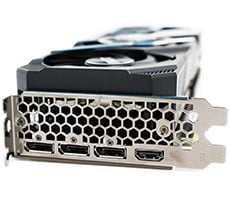
XFX GeForce 8800 Uttra - $639Many vendors are still offering cards based on the formidable NVIDIA 8800 Ultra GPU, but the XFX version seems to strike the best balance between clock speeds and price, without getting into water-cooled territory. Even the memory on this card is clocked higher than NVIDIA's reference spec. You'll recall that we were very impressed when we tested our first 8800 Ultra half a year ago, even if the card didn't represent the best value. If you feel the need for speed, go ahead and grab two and run them in SLI mode, if your motherboard supports it. At about $639 a piece these cards aren't cheap, but they're still the top dog in 3D graphics. If you don't have a six-figure salary and lots of disposable income, don't worry about it! Both AMD and NVIDIA have some very affordable mid-range cards that redefine our expectations of mid-range. On the AMD side of the fence is the Radeon HD 3870. Just one of these cards is more than fast enough to handle today's hottest games, and two can be linked together in a CrossFire configuration for even more performance. Not to mention support for three, and four card CrossFireX configurations is coming early next year. If you haven't read our review of the new Radeon 3000 series cards, you should take a look. These new GPUs are reasonably fast on their own but are designed to work extremely well in pairs or more. NVIDIA hasn't been sitting idle in the mid-range either. Their latest entry, the 8800 GT is a serious performer too as our recent testing indicated. It was really hard to choose between all of the 8800 GT cards available, but in the end we went with the XFX 8800 GT due to the higher clock speeds for a minimal boost in price. There's nothing wrong with the 8800 GT at stock speeds, and XFX offers those too, but we're firm believers that you can never have too much speed, especially if it is only a few dollars more. If you ever feel the need for more power, you can always grab a second card and run them in SLI. While we are very pleased with the mid-range GPUs, we're also impressed with what you can buy for under $200 these days. It used to be that if you bought a video card and spent less than $200, you needed to check product labels to make sure you had enough horsepower to run the latest games. Thankfully those days seem to be a thing of the past, but that doesn't mean you're going to be playing at ultra-high resolutions with all the details turned way up either. Perhaps next year... Sapphire Radeon HD 3850 - $179Perhaps the hardest choice in the video card arena was the low-end AMD/ATI card. There were plenty of great bargains from the last generation of products, but we wanted to recommend something a bit more future-proof. In the end we decided to give the nod to Sapphire's Radeon HD 3850 GPU that we reviewed alongside its bigger brother the HD 3870. It's a little less expensive than the 3870s featuring a full 512 MB of RAM because this variant has 'only' 256MB of GDDR-3 memory and it's clocked lower, but it is a great performer for the price. And if you ever find yourself in the need for more horsepower somewhere down the road, you can always add a second card and run them in CrossFire mode. If you're looking for an affordable NVIDIA solution, then we'd direct your attention to the Asus EN8600GT. What's so special about it other than the fact that it can play DX10 games, and won't break the bank? It's silent. That's right, a silent video card that runs cooler than NVIDIA 8600 GT reference boards thanks to the custom cooling solution. If you're not into silent computing, there are plenty of other 8600 series cards to chose from too, but for the price we honestly think that the EN8600GT can't be touched. There's something to be said for a cool-running and quiet card. We got our first look at the 8600 series GPUs back in April. We thought they were a reasonable value then and we are still impressed with the performance value they represent today. |
| Storage For The Masses: Hard Drives And Optical Drives |
|
Western Digital Raptor WD1500ADFD - $169Special Holiday Deal At NewEgg! Alright, it's trivia time. What's the single fastest desktop SATA hard drive on the market today and has been for three generation of the product line? You guessed it, the 10,000 RPM Western Raptor WD1500. This hard drive may not sport a 3GB SATA interface (SATA 150 only) but its specifications beyond that more than compensate for its lower theoretical interface transfer rate. The Raptor WD1500 comes with a 16MB cache buffer and its 10K RPM rotational speed offers a snappy 5.2ms average access time. Touted as the world's most reliable hard drive, the Raptor WD1500 also offers a 5 year warranty and 1.2 million hour MTBF (mean-time between failure). Though its capacity is a bit on the smallish side, you'll not find a faster SATA hard drive currently. Set two of these bad boys up in RAID 0 and watch the bits fly. Just make sure you have good backup in place for your important data, as you should for any non-redundant RAID mode. If you're looking for a LOT of storage and great performance in a drive, then there is no need to look further than the brand new 1 TB 11th generation Barracuda drive from Seagate. This drive's performance is top notch, with speed and size in one package. This drive features 32 MB of cache, rotates at 7200 RPM, and supports the latest in SATA technology including NCQ. One of the most impressive numbers is its incredibly fast transfer rate. In our tests this massive drive managed to transfer 81.8 MB/sec on average. That's a good number; for reference 80+ MB/sec beats the 74 GB Raptors which once stood at the very top of the SATA HD food chain. If speed and size are important but you don't have bottomless pockets, you might want to take a good look at Western Digital's 500GB Caviar SE16 drive. It performed very well in our battery of tests, and is a bargain considering the size and performance you get for your buying dollar. Despite being available at a great price, this drive is no slouch. We really liked it in our review, and the drive might possibly have earned one of our coveted Editor's Choice Awards if it had come with a 5 year warranty. Still, we were thoroughly impressed that WD packed so much performance and size into such an affordable package. Given that some time has passed since the initial review, the price has only gone down and made this a 'must have' for anyone who likes lots of storage but isn't willing to pay the premium price for TB of 750 GB drives just yet. If you're a starving artist or college student but still need enough space for your, 'ahem', media collection, then you should be interested in the 250 GB Seagate Barracuda 7200.10. While 250 GB might seem small compared to the other drives listed here, it's actually a lot of space for most people. This was the first series of Seagate drives to feature perpendicular recording technology, but that is far from its only claim to fame. Like all Seagate drives, the 250 GB 7200.10 come with an industry-leading 5-year warranty. It also has a large 16 MB cache, and the latest in SATA technology including NCQ. What kind of storage conversation would be complete without the obligatory nod to optical drives? The good news is that for 99.9% of you there are only 2 kinds of drives to consider: a DVD burner or just a normal DVD player. There isn't much of a price difference in these devices anymore, so we only recommend skimping if you're sure that you're NEVER going to want to burn a DVD. Either way we suggest going with a drive that uses the SATA interface. If you want a decent DVD player, we suggest the Lite-On models. It's hard to beat their price and reputation for reliability. It reads DVDs at 16x and comes with a couple of faceplates. If that's all you need in a drive, then this is about the best you're going to find without sacrificing quality. By using the SATA connection that we're recommending for all of our optical drive suggestions, the price might be a little bit higher than its PATA equipped equivalents, but we think it SATA is the way to go if the drive is going to be with you for any length of time. PATA is on its way out. If you're the kind of person who spends a lot of time burning DVDs, your tastes might be a little more discerning. If you're looking for a fast drive that will get the job done without scorching discs or breaking the bank, our suggestion would be the ASUS 20x DVD +/- DVD Burner with LightScribe. If you haven't heard of LightScribe, it's a technology that will allow you to not only burn a disc, but to 'scribe' a customized picture onto the disc's surface. It's not without its flaws, but it is a great way to personalize discs without using paper labels. If you're still scratching your head about LightScribe, consider this: if you took some video footage of a special event (Wedding/birthday, etc.) you could edit the video to your liking then burn it on to a normal DVD. The contents might be impressive, but the disc itself isn't likely to be that impressive. Now, on the other hand, you edit the movie and burn it plus scribe a custom image on the disc surface (maybe the first kiss, or the birthday girl blowing out her candles) and your disc is likely to make a much better impression. |
| Input Devices, Monitors, Sound Cards |
|
We normally avoid low-end wireless keyboards and mice like, but the Cordless Desktop EX110 is a Logitech product. If you've never used a wireless combo by Logitech then you know the EX110 will be well worth the minimal investment. While we can't accurately claim that this is the best wireless setup you'll find. It's certainly one of the most cost effective wireless combos out there, especially for a setup that isn't likely to drive you mad because the mouse or keyboard isn't responding properly. On the downside, you won't be able to tell your friends that you got creamed in your weekly game of Battlefield 2 because your wireless mouse and keyboard weren't up to snuff. Time to start practicing, soldier! If you're looking for something to do with your Bluetooth connection and are also searching for an accurate laser mouse and a keyboard with more functionality than the base models, then you might very well be looking for the Logitech MX 5000 Bluetooth Keyboard & Mouse Combo and not even know it. Let's start with the keyboard. It has all the buttons you'd find on a normal keyboard, plus an LCD screen that lets programs send messages to the LCD, additional macro keys, and a slew of audio control keys. The keyboard can be a little intimidating at first, but once you get used to it, it's hard to go back to a plain vanilla input device. The mouse itself is no slouch, it has a 5.8 MegaPixel scanner and offers 800 dpi resolution. And it can be recharged on the included cradle, so you don't have to buy new batteries every few weeks. The package has other features such as a remote control that is compatible with Media center 2005 and one touch synchronization with many cell phones. All this for less than $100. You might be asking yourself who the heck would charge $250 for a wireless keyboard and mouse combo, and the answer would be Microsoft. You didn't honestly think that Bill Gates got rich selling things at a bargain price, did you? Seriously though, there are reasons this combo is so pricey. Why you ask? Let's start with the futuristic looking keyboard - it is actually rechargeable. Yes, that's right, the keyboard itself can be recharged. And it's got a slew of additional buttons too. You can do everything from check out your favorite web pages to start your media center from this thing. Did we mention that it has an intelligent backlighting system, it's thin, and relatively compact considering all of its features? The included mouse is also a rechargeable piece of brushed aluminum beauty. We haven't felt a mouse that seemed so solid since our good old MX700. There's just something satisfying about a heavy wireless mouse. Did we mention the mouse has 1000 dpi hardware resolution? The monitor is perhaps one of the most under-appreciated parts of the entire computing experience. Regardless of how much RAM/storage/CPU power your machine has, ultimately your interactivity with it boils down to tactile use of the keyboard and mouse plus the visual feedback and from the monitor. We’ll get into sound next, but let’s stick with the visuals for a bit. Our high end pick for monitors is the 30” HP LP3065. Its size is impressive and it has excellent visual quality to boot. The HP LP3065 comes from a name we trust, has a price we think we can all agree with, and 4,096,000 pixels to adore. We have no reservations about recommending the LP3065 as our high-end monitor of choice, that's why it earned a coveted HotHardware Editor's Choice Award and both Dave and Marco use them on their personal rigs. If you're a serious multi-tasker, then you'll love this screen. You can have numerous web pages and other applications up and on the screen at the same time without having to swap back and forth due to the enormous amount of screen real estate. If you’re looking for a monitor at a more down-to-Earth price that still features enough screen real estate to make your neighbors envious we suggest going with a 24” monitor such as the ACER AL2416WBsd. The 24" ACER has a native resolution of 1920 by 1200 which will enable you to enjoy full HD 1080 without any compromises. The only catch is that it only has a DVI input, so if you're running an older video card you'll either need to get a VGA to DVI converter or simply upgrade. All things considered, this monitor is well worth its current street price of $375, and we'd honestly have expected to pay a bit more for such a big, high-resolution screen from a name we know and trust. If you want a quality LCD monitor but still need to make car payments, feast your eyes on the little brother to the AL2416WBsd, the AL1916WAbd. Decoding those long names, we end up discovering that this is a 19" LCD widescreen monitor with a native resolution of 1440 x 900. It's not the largest monitor around, but we think it's a hard act to follow given the price unless you want to buy from a brand that isn't quite so well known. If you do have a discerning ear or the desire to offload more of the audio processing chores to the DSP, you can’t go wrong with one of the X-Fi cards from Creative Labs. If you’re a casual gamer and/or audiophile in training, then we suggest the X-Fi Xtreme Audio, a close cousin to the X-Fi XtremeMusic card we reviewed two years ago. There are very few computer components that wouldn't be considered virtual antiques after two years, but sound cards seem to be a special breed of hardware that don't evolve at the same rate as components such as GPUs or storage. Despite its age the X-Fi family is still the king of the hill. Other companies have tried to challenge Creative Labs but none have managed to wrestle control of the sound card market from them. Creative Labs X-Fi Xtreme Elite Pro - $250On the other hand, if you’re a hardcore audiophile and/or hardcore gamer then there is really only one choice for you: The X-Fi Elite Pro. It comes with a break-out box that lets you easily adjust various settings without the need to exit a full screen program and has a 116 dB signal-to-noise ratio that competes with many 'professional' cards used by movie and music studios. |
| Cases & PSUs |
|
| Summary | |||
Please keep in mind, however, that with the number of different product recommendations on the previous pages, there are a myriad of system configuration options to choose from. For those that are less inclined to shop around though, we've eliminated the hassle and compiled a parts list for a trio of systems...
We hope that you've enjoyed our 2008 Holiday Buyer's Guide as much as we've enjoyed putting it together for you. We here at HotHardware wish you and your families a happy, healthy, and safe fun-filled holiday season. Thank you all for another great year in 2007. See you all again in 2008! Got more recommendations of your own? Discuss in the HH Forum! |