Gigabyte GeForce 8800 GT GV-NX88T512HP

Introduction, Features and Specs

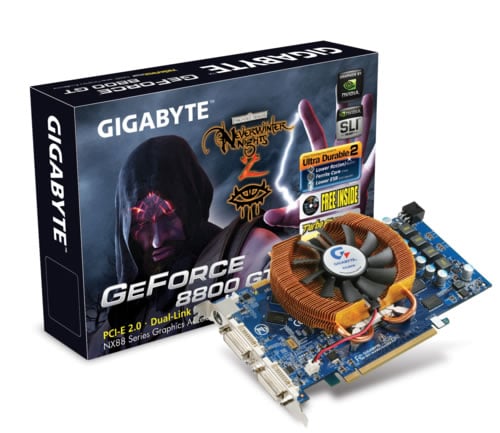
Gigabyte is no stranger to innovation. Year after year, we see the company build unique features into its products to increase performance, improve power utilization, decrease noise, and enhance the user experience. As enthusiasts, we love to see innovations that improve products and differentiate them from the rest of the pack. Gigabyte has done just that with one of its GeForce 8800 GT video cards, the GV-NX88T512HP.
Most companies selling 8800s just use the NVIDIA reference design with a different sticker on the cooler, and sometimes the cards will get overclocked as well. Gigabyte wasn't happy with that idea, though, when it designed its latest 8800 GT TurboForce Edition card, which it called the GV-NX88T512HP. The deviations from NVIDIA's reference design are intriguing to say the least and go well beyond the obvious. Sure, Gigabyte used a very appealing Zalman cooler and even overclocked the GV-NX88T512HP, but that just scratches the surface.
We'll elaborate on what other features make the GV-NX88T512HP special a little bit later. For now, we'll whet your appetite by telling you that Gigabyte overclocked this card's core, memory, and shader clocks to 700 MHz, 920 MHz (1840 MHz DDR), and 1700 MHz, respectively. Recall that NVIDIA's reference clocks are 600 MHz, 900 MHz (1800 MHz DDR), and 1500 MHz, respectively. We have two GV-NX88T512HPs in our labs, so we'll not only be testing its performance in single GPU mode but also in an SLI configuration. If that's not enough to get you to keep reading, then maybe the fact that Gigabyte includes the ability to boost this card's GPU voltage will.
|
|
|

| Fabrication: 65nm Number of Transistors: 754 Million Stream Processors: 112 Memory Interface: 256-bit Frame Buffer Size: 512 MB ROPs: 16 HDCP Support: Yes HDMI Support: Yes Connectors: 2xDual-Link DVI-I 7-Pin TV Out RAMDACS: 400MHz Bus Technology: PCI Express 2.0 Max Board Power: 110 Watts NVIDIA unified architecture: Fully unified shader core dynamically allocates processing power to geometry, vertex, physics, or pixel shading operations, delivering up to 2x the gaming performance of prior generation GPUs. Full Microsoft DirectX 10 Support: World's first DirectX 10 GPU with full Shader Model 4.0 support delivers unparalleled levels of graphics realism and film-quality effects. NVIDIA SLI Technology: Delivers up to 2x the performance of a single graphics card configuration for unequaled gaming experiences by allowing two cards to run in parallel. The must-have feature for performance PCI Express graphics, SLI dramatically scales performance on today's hottest games. NVIDIA Lumenex Engine: Delivers stunning image quality and floating point accuracy at ultra-fast frame rates. 16x Anti-aliasing: Lightning fast, high-quality anti-aliasing at up to 16x sample rates obliterates jagged edges. 128-bit floating point High Dynamic-Range (HDR): Twice the precision of prior generations for incredibly realistic lighting effects - now with support for anti-aliasing. NVIDIA Quantum Effects Technology: Advanced shader processors architected for physics computation enable a new level of physics effects to be simulated and rendered on the GPU - all while freeing the CPU to run the game engine and AI. NVIDIA nView Multi-Display Technology: Advanced technology provides the ultimate in viewing flexibility and control for multiple monitors. Dual 400MHz RAMDACs: Blazing-fast RAMDACs support dual QXGA displays with ultra-high, ergonomic refresh rates - up to 2048x1536@85Hz. Dual Dual-link DVI Support: Able to drive the industry's largest and highest resolution flat-panel displays up to 2560x1600. |
NVIDIA PureVideo HD Technology: The combination of high-definition video decode acceleration and post-processing that delivers unprecedented picture clarity, smooth video, accurate color, and precise image scaling for movies and video. Discrete, Programmable Video Processor: NVIDIA PureVideo HD is a discrete programmable processing core in NVIDIA GPUs that provides superb picture quality and ultra-smooth movies with low CPU utilization and power. Hardware Decode Acceleration: Provides ultra-smooth playback of H.264, VC-1, WMV and MPEG-2 HD and SD movies. HDCP Capable: Designed to meet the output protection management (HDCP) and security specifications of the Blu-ray Disc and HD DVD formats, allowing the playback of encrypted movie content on PCs when connected to HDCP-compliant displays. Spatial-Temporal De-Interlacing: Sharpens HD and standard definition interlaced content on progressive displays, delivering a crisp, clear picture that rivals high-end home-theater systems. High-Quality Scaling: Enlarges lower resolution movies and videos to HDTV resolutions, up to 1080i, while maintaining a clear, clean image. Also provides downscaling of videos, including high-definition, while preserving image detail. Inverse Telecine (3:2 & 2:2 Pulldown Correction): Recovers original film images from films-converted-to-video (DVDs, 1080i HD content), providing more accurate movie playback and superior picture quality. Bad Edit Correction: When videos are edited after they have been converted from 24 to 25 or 30 frames, the edits can disrupt the normal 3:2 or 2:2 pulldown cadences. PureVideo HD uses advanced processing techniques to detect poor edits, recover the original content, and display perfect picture detail frame after frame for smooth, natural looking video. Video Color Correction: NVIDIA's Color Correction Controls, such as Brightness, Contrast and Gamma Correction let you compensate for the different color characteristics of various RGB monitors and TVs ensuring movies are not too dark, overly bright, or washed out regardless of the video format or display type. Integrated SD and HD TV Output: Provides world-class TV-out functionality via Composite, S-Video, Component, or DVI connections. Supports resolutions up to 1080p depending on connection type and TV capability. Noise Reduction: Improves movie image quality by removing unwanted artifacts. Edge Enhancement: Sharpens movie images by providing higher contrast around lines and objects. |

;)
;)
We were happy to see that Gigabyte chose a rather small box to house its GV-NX88T512HP. The box is not much bigger than it needs to be to protect the card and accessories. The box features a character from Neverwinter Nights 2, which as you can see in the first shot below is included with the card. As expected, the back of the box touts the features and specs of the card found inside.
;)
;)
Along with the GV-NX88T512HP itself, Gigabyte includes the following accessories: a full version of Neverwinter Nights 2, a driver/utility CD, a manual, a quick install guide, two DVI-to-VGA adapters, a PCI Express power connector, and a component/S-video out cable. We can't say that the inclusion of Neverwinter Nights 2 is terribly exciting, but maybe some of you will find it appealing. It is worth noting that the game has garnered an average score of over 80% in reviews from respected sites across the web.